

Video

Finding space for a reliable HF antenna in a small garden is a common challenge. Fortunately, there are several compact, multiband designs that punch well above their weight. Below are four practical antennas that are compact, relatively simple to build or buy, and proven to work from modest heights and cramped layouts. Each antenna includes feeding and matching tips, real-world performance notes, and installation advice so you can choose the best option for your situation.
Quick overview: the four contenders
- Half‑size G5RV (≈51 ft) fed with 450 Ω ladder line and a 1:1 balun
- End‑Fed Half‑Wave (EFHW) — 66 ft length with a 49:1 unun
- “Random” wire (specific lengths) — 71 ft with a 9:1 unun and a longer coax run
- Invisible short vertical — ~13 ft vertical with a 4:1 unun and radials
General feeding, matching and measurement tips
Before jumping into each antenna, a few practical points apply to all of them.
- Use a line isolator close to where coax first connects to the antenna system. A ferrite core with roughly 8–10 turns of coax will help prevent common mode currents, give more reliable VSWR readings and stop the transceiver’s tuner from struggling.
- Know the difference between true VSWR and the transceiver’s apparent VSWR. An external VSWR meter will show the actual line mismatch. The radio’s internal tuner will present a lower apparent VSWR to the transmitter once it matches, but the external meter still reports the line’s true standing wave ratio.
- Modern transceivers have capable internal tuners. Many modern radios will match these antennas across 40–10 m and, in some cases, even beyond. Still, reducing feedline loss with ladder line or by keeping feedline lengths reasonable is helpful.
- Pay attention to mechanical routing. In small gardens the antenna will often need to be bent, dropped, or routed around obstacles. These antennas tolerate that reasonably well, but thoughtful routing helps avoid unwanted interactions with metal fences and gutters.
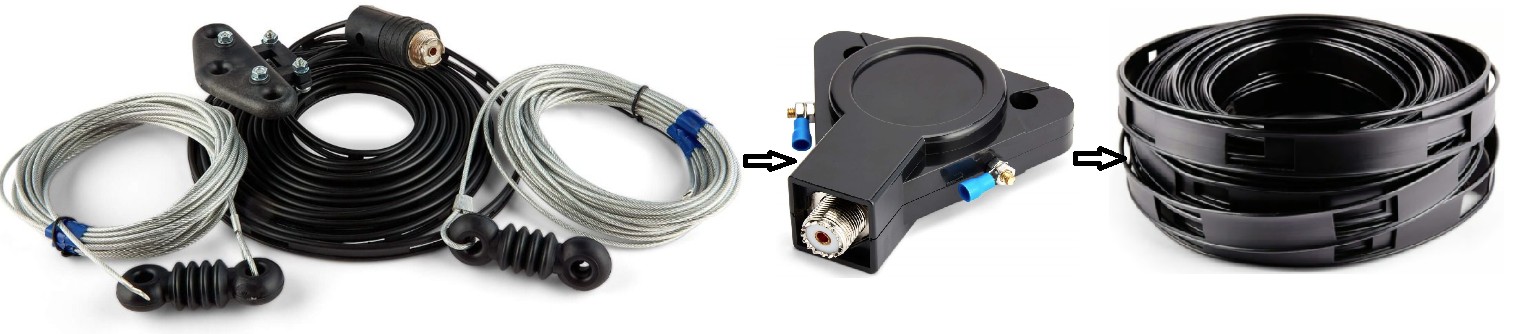
The half‑size G5RV is essentially a shortened G5RV dipole and works on 40, 20, 15 and 10 m, with some usable performance on the WARC bands. It’s a very practical multiband option for a small garden because the overall footprint is modest and it pairs well with ladder line feeding.
How it’s built and fed ?
Typical layout: a 51 ft wire cut to the G5RV half‑size proportions, fed with 450 Ω ladder line (about 17 ft in the classic arrangement) into a 1:1 balun (though a 4:1 can be used in some setups). From the balun, run a short coax into the shack.
Installation tips -
- Run the 450 Ω ladder line either to a balun at roughly 17 ft from the wire or take the ladder line all the way back to an outside wall and place the balun there. A balun on the outside wall keeps common mode currents outside the house.
- Use a small external VSWR meter if you like, but the transceiver’s internal tuner will usually be able to match the antenna across the main HF bands.
- If you experience matching issues, altering the ladder line length is often an easy way to improve the match. Ladder line reduces loss compared with coax when the feed is mismatched.
- Fit a line isolator (ferrite choke) right where the coax first connects to the antenna system to stabilise readings and tuner behaviour.
Performance notes -
The half‑size G5RV surprises many with how well it performs from modest heights. At around 28 ft, it will often make long‑haul contacts (for example, into the Pacific on 40 and 20 m). For many night and early morning contacts, skywave propagation and chordal hop mean you do not always need extremely low takeoff angles to work DX.
Pros and cons -
- Pros: Multi‑band, relatively quiet, efficient with ladder line, straightforward to install.
- Cons: Needs a balanced feed and a balun/unun arrangement; full‑size G5RV is too long for small gardens but the half‑size works well.
2. End‑Fed Half‑Wave (EFHW) with 49:1 unun — the workhorse
The EFHW has become very popular because it is simple to put up and can be coax‑fed directly to the shack via a single feed point at the end. For the smallest gardens choose a 66 ft half‑wave length for 40 m. The EFHW covers 40, 20, 15 and 10 m very reliably.

How it’s built and fed ?
Use a 49:1 unun at the feed point, connect coax from the unun back to the transceiver, and include a line isolator before the radio or the external VSWR meter.
Layout flexibility -
The EFHW accepts bends and drops. If the garden isn’t long enough for a straight 66 ft run, bend the wire left or right, or drop the far end down vertically. The antenna tolerates gentle bends with minimal performance loss.
Pattern and behaviour -
On the fundamental frequency (40 m), the EFHW behaves much like a horizontal half‑wave dipole. On harmonics (20, 15, 10 m) the radiation pattern becomes more complex with multiple lobes — sometimes that helps, sometimes it means the antenna has nulls in unwanted directions. That behaviour is typical of end‑fed half waves and worth accepting for the simplicity they offer.
Pros and cons -
- Pros: Very easy to install, single‑wire feed, compact routing options, reliable on 40–10 m.
- Cons: Requires a good 49:1 unun rated for your power (many are sized for up to ~200 W), harmonic patterns can produce lobes and nulls.
3. “Random” wire — a 71 ft wire with a 9:1 unun
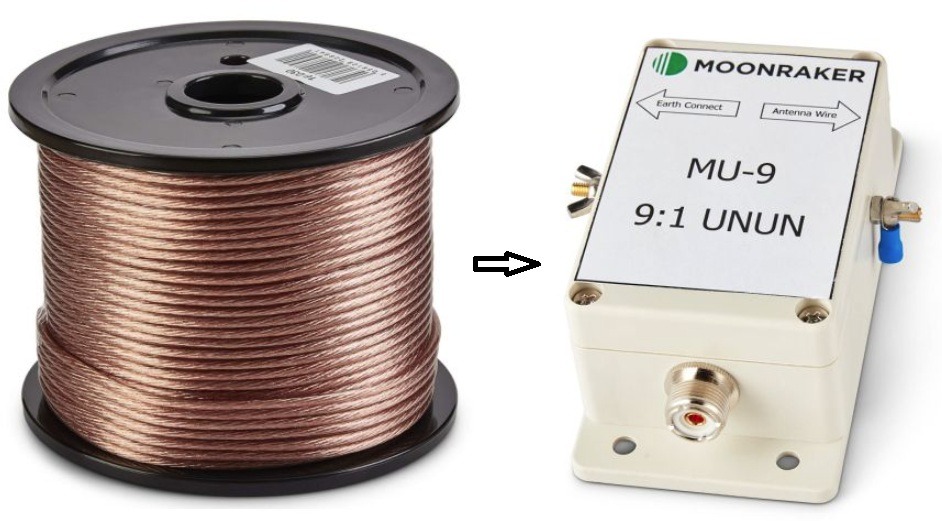
What is often called a random wire is not truly random; certain lengths give excellent multiband coverage. A 71 ft wire fed with a 9:1 unun is a very capable multiband option. The magic here is the interaction between the wire, the unun and the coax feed.
Feeding and why coax length matters?
The 9:1 unun feeds coax back to the shack. Unlike balanced ladders, the coax outer conductor will often participate in radiation with these unbalanced arrangements. That means the length of the coax becomes part of the antenna system and, crucially, it often takes about 50 ft of coax to achieve a good match across 40–10 m in this configuration.
Essential items -
- 9:1 unun with sufficient power rating for your transmitter.
- Line isolator (ferrite choke) immediately before the VSWR meter or the transceiver to tame common mode currents and stabilise matching.
- Expect to experiment with coax length and routing; changes can alter tuning and pattern.
Performance notes -
With the right coax length and a decent internal tuner, this setup can cover 40, 30, 20, 17, 15, 12 and 10 m. In some installations and with a wide‑range internal tuner it may even be possible to coax the system into 80 m and 160 m. Results depend on the radio’s tuner range, the unun used, and the feedline details.
Pros and cons -
- Pros: Extremely compact, multi‑band, easy to fit into odd shapes, good if you want one wire that covers many bands.
- Cons: Coax may radiate so take time to fit a proper choke, matching can be sensitive to coax length and routing, and the unun must be chosen for your power level.
4. The invisible short vertical — ~13 ft with a 4:1 unun
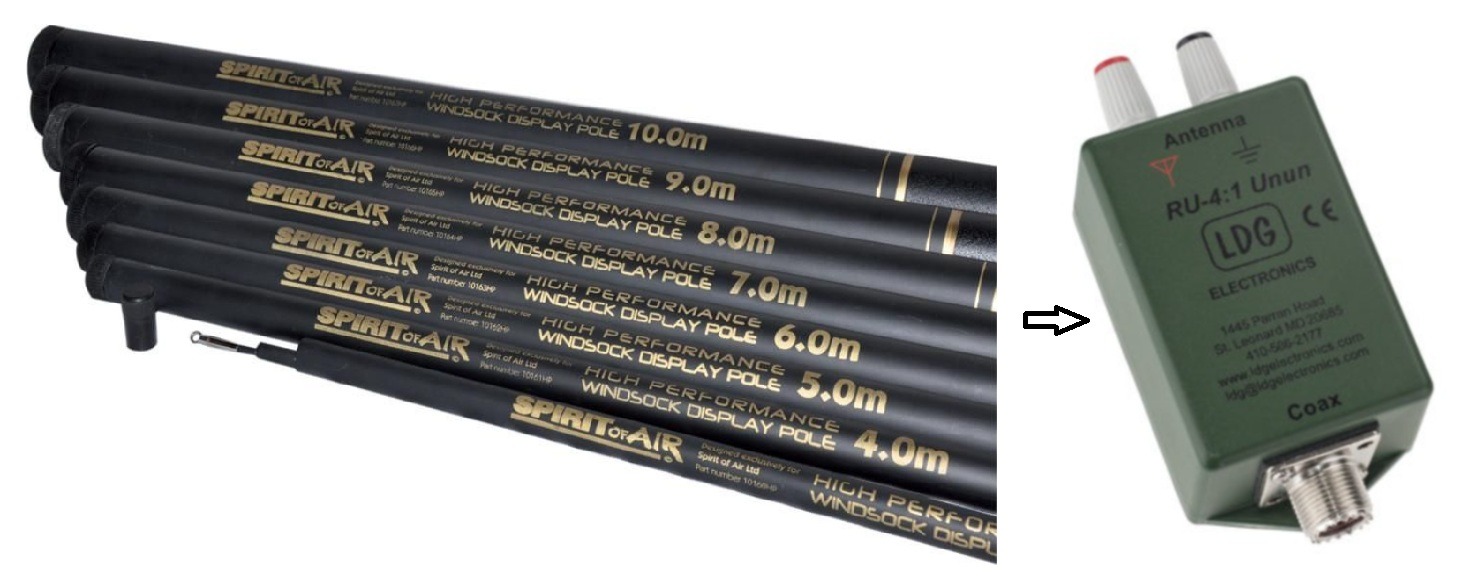
This compact vertical is ideal when you need something discreet. It’s a short vertical (roughly 13 ft) that can be taped to a slim fibreglass pole or hung from a tree. A 4:1 unun at the base transforms the feed and a set of radials provides the ground return.
Why “invisible” ?
The antenna is short and can be mounted on thin poles or branches, so it is not visually intrusive. In many installations neighbours will not notice it, which helps where planning or aesthetics are a concern.
Grounding and radials -
Because this is a vertical, it needs radials. Even a set of elevated radials or a handful of ground radials laid on the lawn will significantly improve efficiency. The more radial length and number you can fit, the better the low‑angle radiation and the lower the ground losses.
Feeding and matching -
- Mount a 4:1 unun at the base and feed with coax to the shack.
- Place a line isolator just before the radio or the VSWR meter to control common mode currents.
- This vertical reliably covers 20–10 m and will give useful performance on the DX bands.
Noise and local environment -
Be aware that verticals tend to pick up more local noise than horizontal antennas. In electrically noisy neighbourhoods this may be a limiting factor. If your garden is in a quiet RF environment the invisible vertical can be surprisingly effective and unobtrusive.
Pros and cons -
- Pros: Very compact, discreet, covers the DX bands well, easy to disguise or mount.
- Cons: Requires radials, can be noisier than horizontal antennas, and needs a solid base mounting for the unun.
Practical setup checklist
When installing any of these antennas, work from this basic checklist to reduce frustration and speed up getting on air:
- Choose the antenna that best fits your garden footprint and target bands.
- Select the correct unun/balun: 49:1 for EFHW, 9:1 for random wire, 4:1 for the short vertical, 1:1 balun for ladder line to coax transitions.
- Fit a line isolator (ferrite choke) immediately where coax connects to the antenna feed to reduce common mode current.
- Use ladder line for the half‑size G5RV where possible to reduce feedline losses when mismatched.
- Experiment with coax length on the random wire system — around 50 ft is often a good starting point.
- Keep the unun’s power rating above the transmitter’s maximum output.
- Install ground radials for verticals and check the radio’s internal tuner for bands outside the antenna’s resonance.
- Record what you try — small changes to routing can make large differences in match and performance.
Real‑world notes and myths
Two ideas often surface when discussing compact HF antennas: that you must have extremely low takeoff angles to work DX, and that an antenna must be perfectly flat and symmetrical to perform. Both are overstated.
Many long‑path contacts, for instance into the Pacific, can be achieved with modest antenna heights thanks to ionospheric propagation and chordal hop. I have routinely worked far‑off stations on 40 and 20 m from only around 28 ft height with the G5RV and EFHW setups. Antennas that are bent around a garden still radiate effectively, especially for ionospheric paths that don’t require ultra‑low takeoff angles.
Finally, don’t be afraid to try multiple options. Different antennas will shine under different propagation conditions and at different times of day. A practical approach is to fit one antenna, get familiar with its quirks, and then try another to see the differences in noise, signal strength and directionality.
Which antenna should you pick?
Here’s a short guide to help decide:
- For simplicity and easy installation: EFHW with a 49:1 unun.
- For lowest feedline loss and multi‑band flexibility: Half‑size G5RV with 450 Ω ladder line and a 1:1 balun.
- For odd‑shaped gardens and maximum band coverage from one wire: 71 ft random wire with a 9:1 unun and a longer coax run (experiment with ~50 ft coax).
- For stealth and small footprint: Invisible short vertical with 4:1 unun and radials.
Final thoughts
Small gardens need not keep you off HF. With a little planning — the right matching devices, a ferrite line isolator, and some willingness to experiment with routing or coax lengths — you can have a compact multiband antenna that gets you regularly on the air and into DX. Try one design and then try another; each has strengths that may suit different times or propagation conditions.
Above all, focus on practical, secure installations and use the radio’s tuner wisely. Good antennas do not have to be large to be effective; they simply need to be well matched and thoughtfully deployed.
For more information please visit our online store or alternatively contact us and our team will be happy to assist you.