
Have you ever thought about becoming a spy radio operator? No, I am not offering anyone a job. But it is an interesting thought.
A surprising number of amateur radio operators already have many of the skills that would once have been essential behind enemy lines. Morse code, compact stations, batteries, wire antennas, difficult propagation, operating from unfamiliar locations, and the determination to get a message through with very little power.
It all sounds rather familiar, does it not?
Some of us may be a little long in the tooth for the espionage business now, of course. Still, looking back at the world of wartime clandestine radio makes modern QRP operation seem even more interesting.
Radio Was the Essential Link Behind Enemy Lines
The great age of spy radio was undoubtedly the Second World War. Intelligence agents operating in occupied territory needed a reliable way to pass information back to their side. Portable transmitters and receivers provided that link.
Agents could report troop movements, military installations, and other vital information. Messages were generally sent in code or cipher, so that interception alone would not reveal their contents. The radio operator's task was not simply to transmit. It was to send accurately, quickly, discreetly, and with as little chance of being found as possible.
That last point was rather important. An enemy force listening on the right frequency could use direction finding equipment to trace a transmission. For that reason, radio operators had to move regularly. Remaining in one place for too long could be extremely dangerous.
Even Receiving Could Be Risky
Early in the war, listening could be a risk as well. Some receivers used regenerative detectors, which could radiate a very small signal. In other words, an agent could potentially be detected even while receiving.
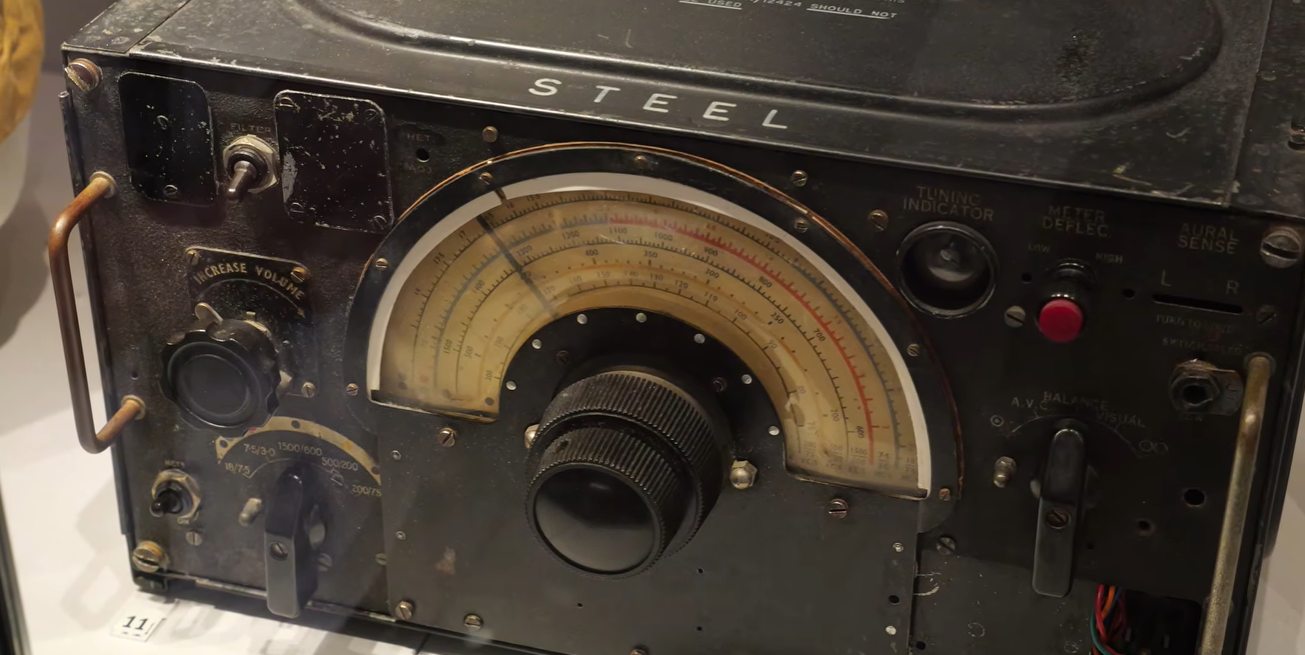
Radio equipment was also far less convenient than it is today. Valve equipment required heater power, plus a high tension supply. Although battery valves existed, the batteries and power arrangements occupied considerable space. A portable station was often heavy, bulky, and not especially easy to conceal.
By today’s standards, even the more sophisticated wartime sets were substantial pieces of equipment. Carrying one around in a suitcase may have been practical, but it could hardly have been entirely inconspicuous in occupied Europe.
The Modern QRP Transceiver Is a Remarkable Contrast
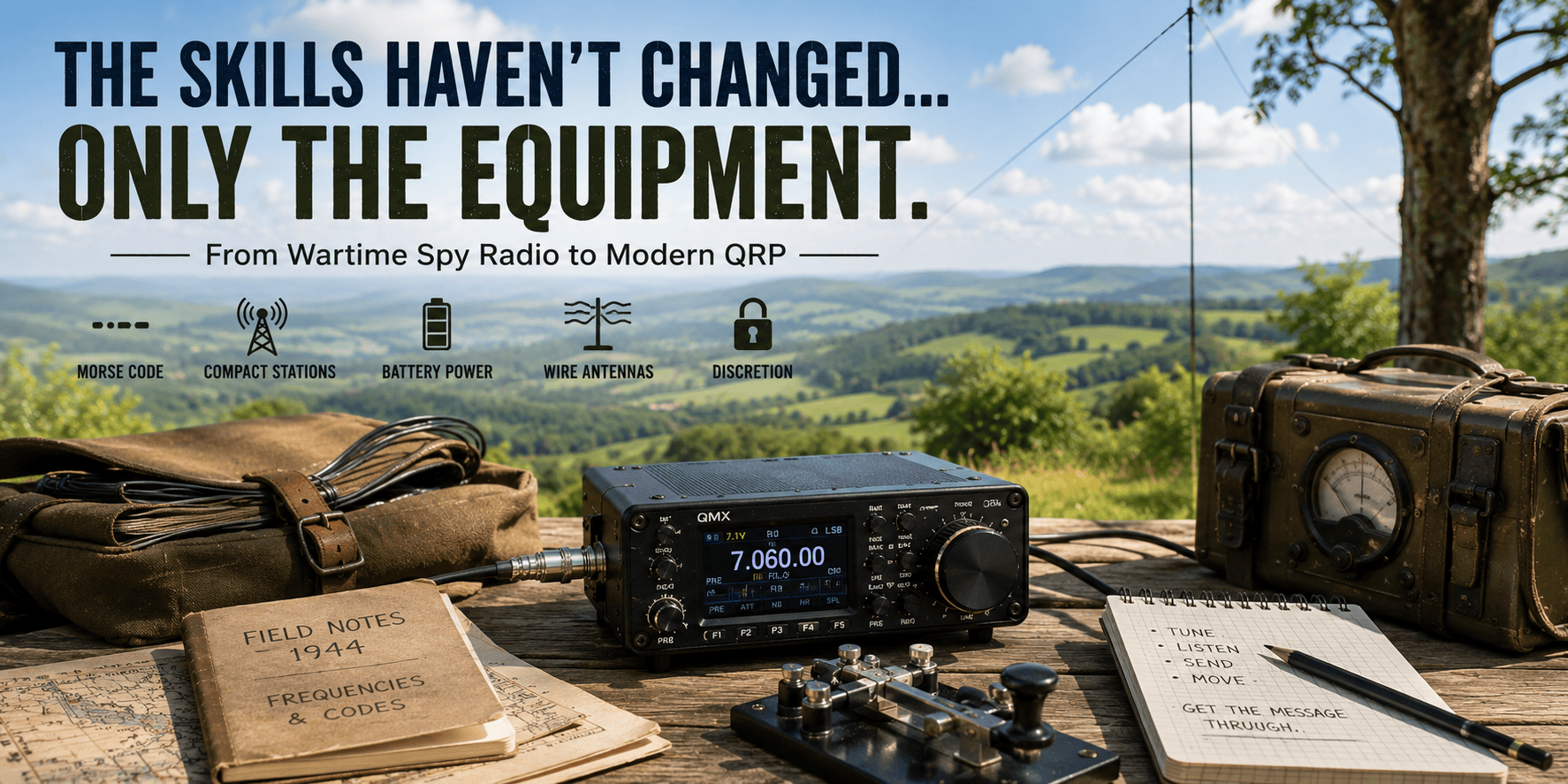
Now compare those wartime stations with a modern compact transceiver such as the QMX. Here is a tiny radio powered by a small battery for several hours of operation. It can produce around four or five watts on Morse code and can also handle SSB. With its display, tuning accurately to a chosen frequency is straightforward.
It is astonishing to think what can now be carried in a pocket or small bag. The radio is small, the battery is small, and the operating capability is impressive. In practical terms, it is hard not to think that this sort of equipment would make a very capable clandestine transceiver, at least from a purely technical point of view.
Of course, the radio is only half the station. The real secret of a good signal remains the same as it has always been:
You need a decent antenna.
The Antenna Challenge: Then and Now
Putting up an antenna in a garden in broad daylight is one thing. Putting one up discreetly, at night, under pressure, with no time to spare, is quite another matter.
Wartime agents had to erect aerials quickly and carefully, often in circumstances where being noticed could have serious consequences. That demanded practical skill, ingenuity, and a clear understanding of how to make the most of whatever was available.
There is a real connection here with portable amateur radio, especially QRP, Parks on the Air, and Summits on the Air operation. When operating from a park, hilltop, or other temporary location, you often have no idea exactly what will greet you.
- Will there be a suitable place to support a mast?
- Will there be trees or branches for a wire antenna?
- Will the antenna fit the available space?
- Will conditions allow a low power signal to be heard?
- Will an adjustment to the antenna or operating frequency make all the difference?
That is where the satisfaction lies. You may have only a small battery, a few watts, a length of wire, and a simple mast. The location may be far from ideal. The antenna may be a compromise. But getting on the air and making contacts is a proper challenge.
It is not the same danger faced by wartime agents, thankfully, but the operating mindset has similarities. Work with basic equipment. Adapt to the location. Make the best of the antenna you can deploy. Understand propagation. Keep trying until the signal gets through.
Why Shortwave Radio Was So Valuable
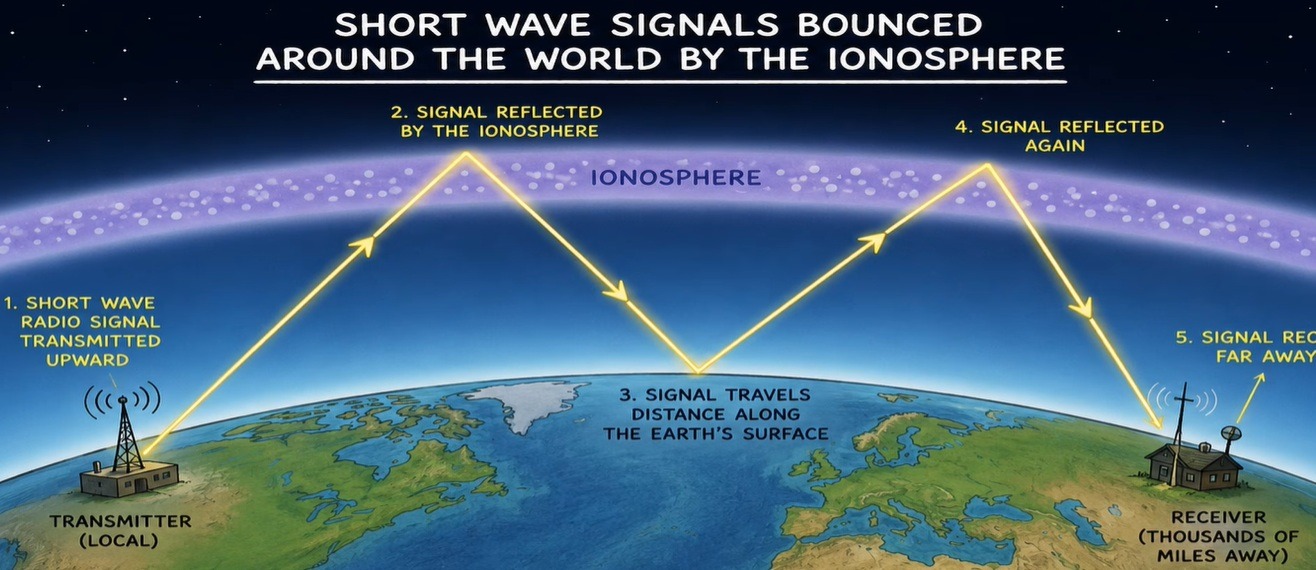
Today, long-distance communication depends heavily on satellites and internet infrastructure. During the war, shortwave radio was one of the most dependable means of sending information across great distances.
The ionosphere did the work. Signals could be reflected back to Earth and travel hundreds or thousands of miles, connecting agents in occupied Europe with stations far away.
Amateur radio operators still rely on the same natural phenomenon. Propagation can be frustrating, unpredictable, and absolutely fascinating. Yet it has one obvious advantage over many modern communication systems: nobody can shoot down the ionosphere.
A Visit to Manchester’s Imperial War Museum
A visit to the Imperial War Museum North in Manchester brought this whole subject to mind. A special exhibition on spies showed the ingenuity, creativity, and nerve required for undercover work.
One of the strongest themes running through the exhibition was the need for communication. Agents needed to receive instructions, pass intelligence, and maintain contact without exposing themselves. Radio was at the centre of it all.
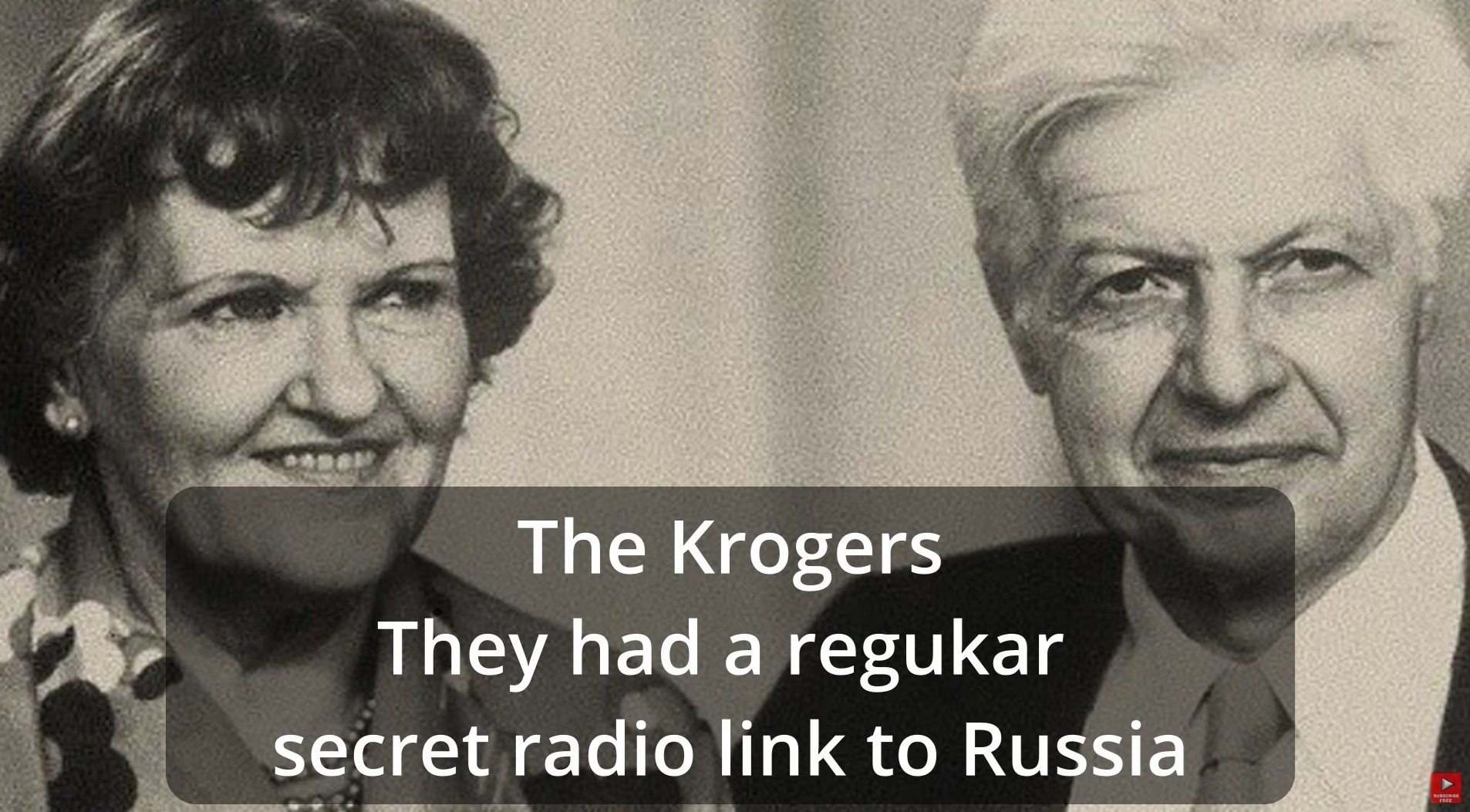
The exhibition also brought back memories of the Kroger spy case and the film Ring of Spies, which tells the story in compelling fashion. It is still available online and is well worth seeking out for anyone interested in Cold War espionage and covert radio communications.
The Portland Spy Ring and the Radio Hidden Beneath a Floor
The story of Peter and Helen Kroger is one of the best known British espionage cases of the period. Their home at 45 Cranley Drive, Ruislip, Middlesex, appeared to be an ordinary suburban bungalow. Behind the lace curtains, however, it was a centre for passing information to the KGB.
The Krogers were not their real names. They had established themselves comfortably in the neighbourhood, maintaining friendly local relationships. Peter was known as a bookseller, apparently sending books around the world. It all looked perfectly respectable.
But the bungalow concealed an elaborate intelligence operation.
How the Information Was Obtained
MI5 had become aware that documents from the naval establishment at Portland in Dorset were being passed to the KGB. The investigation eventually focused on Harry Houghton, whose lifestyle appeared to exceed what his official salary could reasonably support.
Houghton worked with Ethel Gee, who had access to a safe containing sensitive documents. He persuaded her to leave the safe unsecured for a brief period on Fridays.
Friday was chosen for a very practical reason. The office closed for the weekend, so documents could be removed, copied, and returned before Monday morning. If all went to plan, nobody would realise they had been absent.
Houghton took the documents to London, where they reached Gordon Lonsdale, a man holding a Canadian passport but in fact connected with the KGB. Lonsdale then delivered the material to the Krogers at Cranley Drive.
Microdots, Books, and Coded Radio Messages
At the bungalow, Peter Kroger photographed documents and produced microdots. These tiny photographic images could be concealed on the page of a book. The book would then be sent to a pre-arranged address in Eastern Europe.
The radio station hidden beneath the floor was used to tell the KGB where to find the information. A telescopic aerial was extended up the chimney, forming a vertical antenna. Using coded messages, Kroger could identify the book, the destination, and the relevant page.
It was a clever and carefully constructed system. The radio equipment, the concealed antenna, the apparently innocent book business, and the coded communications all formed part of a serious spy network that became known as the Portland spy ring.
Eventually, those involved were arrested and imprisoned. The case attracted huge attention in the newspapers during the late 1950s and early 1960s.
There was a sad human side to the operation too. Neighbours who had been friendly with the Krogers became caught up in the strain of the surveillance. MI5 occupied a neighbouring house for weeks to observe the bungalow, and the pressure placed on one of the neighbours had a deeply damaging effect on her health.
Portable Ham Radio Has the Same Spirit of Resourcefulness
To be clear, QRP operators, POTA activators, and SOTA activators are not spies. Most do not carry their station around in a suspicious suitcase either.
But there is a similarity in spirit. Portable amateur radio encourages self-reliance. You take a simple station into an uncertain operating environment and make it work.
You may not know what antenna can be put up. You may not know whether there is room to deploy a wire. You may not know how conditions will behave. You may not even know whether four or five watts will be enough that day.
Yet you go out with a battery, a compact radio, a bit of wire, and the determination to communicate. That is the challenge, and that is the appeal.
Low Power Operation Is More Than a Technical Exercise
QRP operation is sometimes viewed simply as using less power. It is more than that. It rewards patience, careful listening, good antenna choices, awareness of propagation, and the willingness to adapt.
A powerful station can overcome many shortcomings. A low power station makes you think. It encourages you to improve your operating technique and to appreciate every successful contact.
Perhaps that is why the history of spy radio holds such fascination for amateur radio operators. The equipment may have changed beyond recognition, but the underlying challenge remains remarkably familiar: make the most of limited resources and get the message through.
Whether operating from a summit, a park, a garden, or a temporary location with a modest wire antenna, there is great satisfaction in proving that a simple station can still reach out across the world.
