
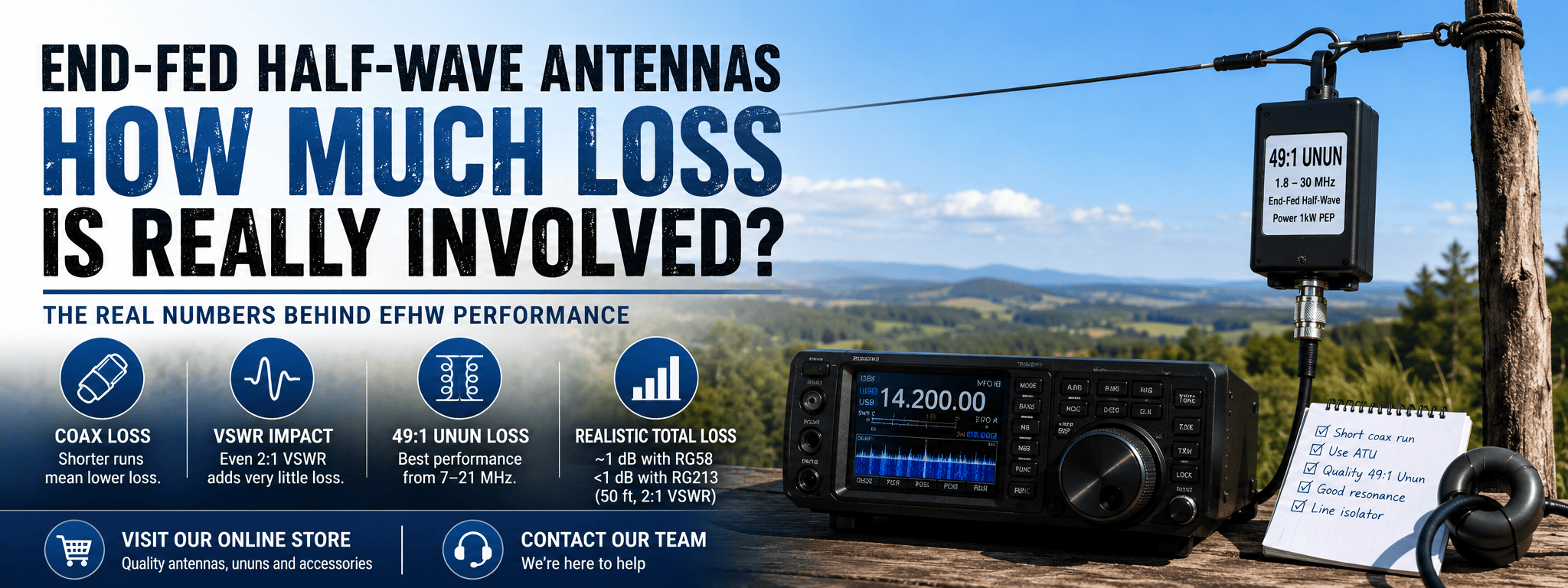
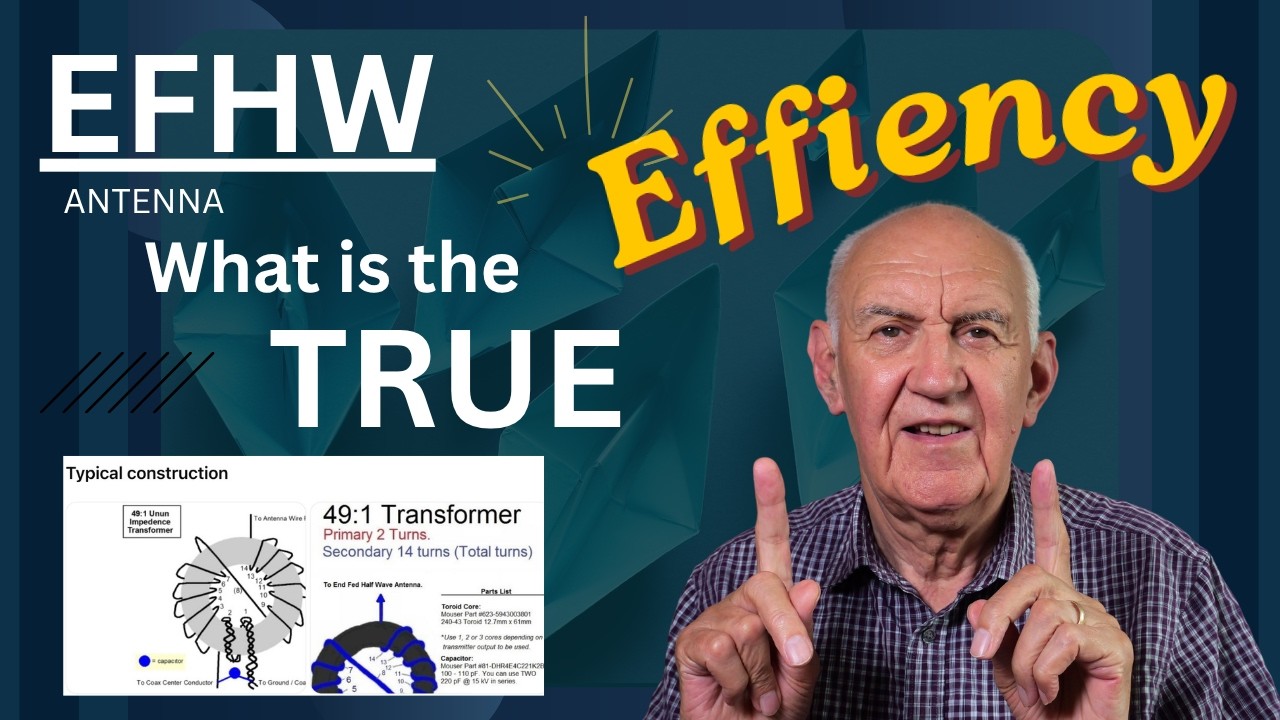
End-fed half-wave antennas have become one of the most popular ways to get on the air with a simple multiband setup. They are easy to put up, easy to take down, and for many stations they work surprisingly well.
At the same time, this antenna seems to attract strong opinions. Plenty of operators rate the EFHW very highly. Others dismiss it as noisy, inefficient, or compromised. So the sensible question is this: how much loss is really involved in a typical end-fed half-wave installation?
Once you break the system down into its parts, the answer becomes much less dramatic than the debate around it.
What an end-fed half-wave antenna actually is
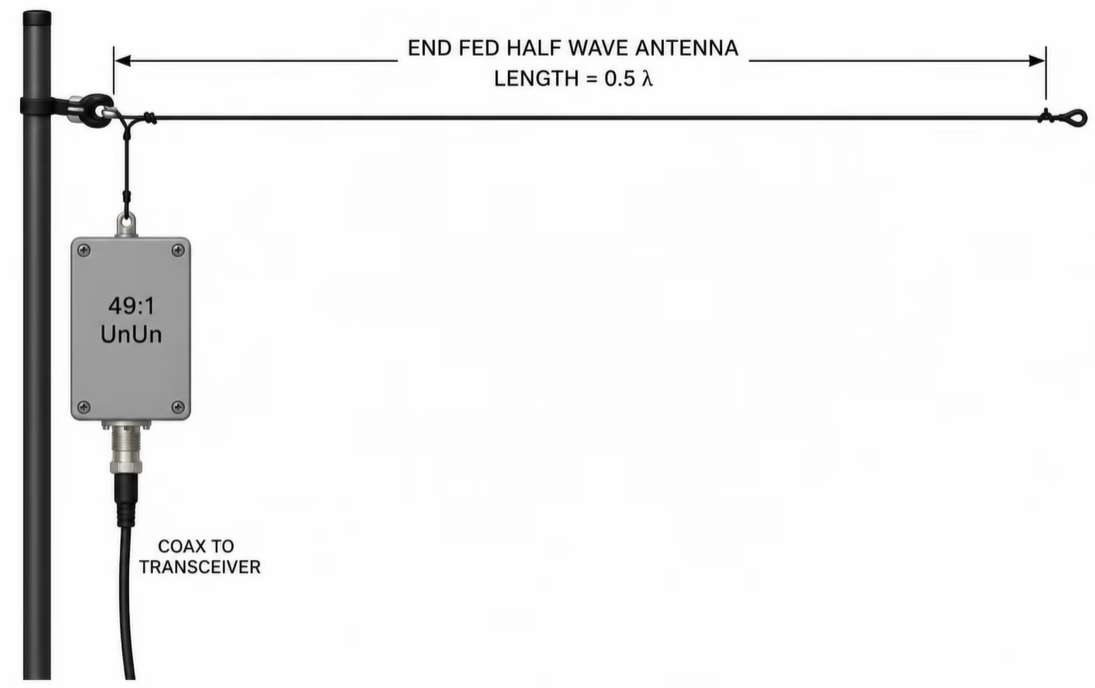
An end-fed half-wave, or EFHW, is simply a length of wire that is resonant as a half-wave on its lowest design band. Because it is a half-wave radiator on that fundamental frequency, it can also operate on harmonic bands above it.
A common example is a wire around 20 metres long. That would be resonant on 40 metres and also usable on 20, 15, and 10 metres.
Because the end of a half-wave wire presents a high impedance, it is normally fed through a 49:1 unun. That transformer brings the impedance into a range that can be fed with coax back to the transceiver.
So when people talk about EFHW efficiency, they are usually really talking about three things:
- The loss in the coax cable itself
- The extra coax loss caused by VSWR
- The loss in the 49:1 transformer
Why antenna losses often sound worse than they are
Losses can sound alarming when they are expressed one way, and almost trivial when expressed another way.
Suppose someone says you are losing 10 percent of your transmitter power. That sounds painful. If you are running 100 watts, hearing that only 90 watts makes it to the antenna can make it feel as though something is badly wrong.
But express that same loss in decibels and it becomes a very small figure. Suddenly it no longer sounds catastrophic. It is the same reality, just framed differently.
That is often the trap with antenna discussions. People hear "loss" and imagine something enormous, when in practice the difference may be small enough to be barely noticeable on the air.
As a rough guide, a change of 1 dB is only just detectable. Anything less than that is very small indeed.
The first source of loss: coax cable
Every coax cable has loss. That is true whether you are feeding an EFHW, a dipole, or a vertical. There is no such thing as lossless coax.
The amount of loss depends on:
- The type of coax
- The frequency
- The length of the run
That last point matters because one advantage of an end-fed half-wave is that it often uses a relatively short length of coax. The feedpoint is usually near the end of the wire, often close to where the wire rises up the support. In many stations, the coax simply runs from the shack to that transformer point.
For a typical home installation, a coax run of around 50 feet is a realistic upper figure. Quite often it is less.
That means the coax loss in an EFHW system is often modest simply because the feedline is not especially long.
Should you upgrade to thicker coax?
Possibly, but it is worth checking the actual improvement before spending the money.
Many operators assume that moving from a lighter cable such as RG58 to a thicker cable such as RG213 must produce a major gain. Sometimes it does help, but if the coax run is short and the operating frequency is moderate, the improvement may be less than expected.
If the difference comes out at less than 1 dB, then in practical terms it is a very small change. That does not mean it is worthless, but it does mean the gain may not justify the extra cost, weight, or inconvenience.
Perfection is attractive in theory, but in real stations there are plenty of cases where "good enough" really is good enough.
How VSWR affects coax loss
Once the match becomes less than perfect, coax loss increases. That part is true. But the important point is how much it increases.
With a typical end-fed half-wave, the VSWR is often not especially high. Around the band edges you might see something like 2:1, and quite often it will be lower than that.
For a short run of coax on bands such as 40 metres or 20 metres, the difference in loss between a perfect match and a 2:1 match is generally very small. It is commonly well under 1 dB.
That tends to surprise people, because VSWR has a reputation for sounding frightening. In reality, on moderate HF frequencies and sensible feedline lengths, a 2:1 VSWR does not suddenly turn the coax into a giant dummy load.
The bigger issue is often the transceiver, not the coax
Where VSWR does matter more is at the radio end. Many transceivers do not like seeing a high mismatch. Once the SWR starts climbing to around 2:1 or above, the rig may begin reducing output power to protect itself.
That is not the coax "eating" the power. It is the transceiver backing off because it is uncomfortable with the mismatch.
The usual cure is straightforward:
- Use the internal ATU if the transceiver has one
- Or use an external matching unit
This does not remove the mismatch on the coax itself, but it presents a comfortable load to the transceiver, allowing it to deliver full power without reducing output.
So if you are judging EFHW performance, do not confuse transmitter power foldback with feedline loss. They are related to the same mismatch, but they are not the same thing.
The second source of loss: the 49:1 unun
The transformer is the part of the end-fed half-wave that makes many people uneasy, and fairly so. Unlike coax, where losses are well documented, manufacturers do not always publish clear insertion loss figures or frequency response curves for their 49:1 ununs.
Still, there are some broad patterns that are well understood for the common designs built around ferrite cores such as the FT240-43.
Where the transformer works best
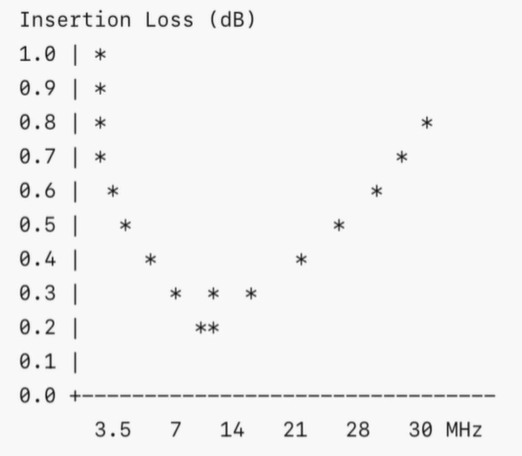
A typical 49:1 transformer tends to have a sweet spot somewhere around 7MHz up to roughly 14 or 21 MHz. In other words, it is generally happiest in the middle HF range.
As you move lower in frequency, losses usually rise.
As you move higher in frequency, losses also tend to rise.
And just as with coax, transformer loss gets worse if the antenna is not well matched.
So the transformer is not equally efficient everywhere. It has a range where it behaves very well, and performance tails off outside that range.
Transformer quality matters
If you want to minimise loss, it is worth using a properly rated unun rather than the lightest possible version.
Even with a 100 watt transceiver, there can be an advantage in choosing a higher power rated EFHW transformer. Higher rated units often use:
- Heavier windings
- Larger or stacked ferrite cores
- A design that runs with lower stress at normal power levels
Ferrite transformers generally become more lossy as they are pushed closer to their limits. At lower power levels, losses are typically reduced. So an overrated transformer is not only about durability. It can also help efficiency.
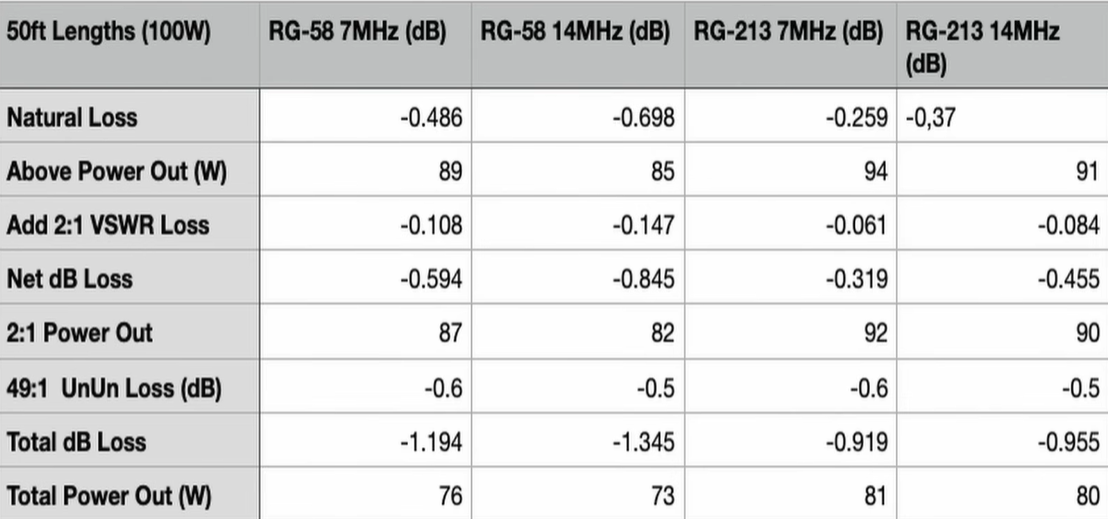
What a realistic total loss looks like
For a sensible example, consider:
- A 50 foot coax run
- Either RG58 or RG213
- Operation on 7 MHz and 14 MHz
- A VSWR of around 2:1
- A typical 49:1 transformer loss added in
Under those conditions, the overall losses are not especially dramatic.
With RG58, the total loss comes out at a little over 1 dB.
With RG213, the total loss comes out at under 1 dB.
And remember, those figures already assume a 2:1 VSWR, which is not a perfect match. If your antenna is better matched than that, the losses will be lower again.
That puts the whole discussion into perspective. The EFHW is not lossless, but neither is it the sort of disaster some critics suggest.
What happens as you move off resonance
The numbers above assume a good installation with the antenna set up and resonant on the intended bands.
As soon as you move away from that condition, two things begin to happen:
- The SWR on the coax rises, increasing feedline loss
- The loss in the transformer also tends to increase
That is why tuning, wire length, and general installation still matter. An EFHW that is sensibly cut and properly deployed will behave much better than one that is badly adjusted and pressed into service well away from where it wants to operate.
So when people report poor performance from an end-fed half-wave, it is worth asking whether the problem is really the concept of the antenna, or whether the installation is simply operating too far from optimum.
How EFHW losses compare with other antennas
It is important to keep comparisons fair.
Coax loss exists in all systems. A dipole has coax loss. A vertical has coax loss. An EFHW has coax loss. The EFHW is not unique in that respect.
In fact, because the feedline run is often shorter, the end-fed half-wave can even enjoy a slight advantage there.
The transformer does add another source of loss, of course, but that needs to be judged in context. Multiband antennas almost always involve compromise somewhere. Trap dipoles have trap losses. Other matching arrangements introduce their own inefficiencies. There is no free lunch with multiband operation.
That is why the playing field is more level than it first appears. Once you compare like with like, the EFHW sits quite comfortably alongside other practical HF multiband antennas.
Practical advice for getting the best from an EFHW
If you are using an end-fed half-wave or considering one, a few practical points make a real difference:
- Keep the coax run sensible. Shorter feedlines mean lower loss.
- Check the real benefit before changing coax. A more expensive cable is not always a meaningful upgrade over a short distance.
- Use the ATU when needed. This helps the transceiver deliver full power even if the feedline match is not perfect.
- Choose a decent 49:1 transformer. A well-built, higher rated unit will usually perform better and run with lower losses.
- Set the antenna up properly. Good resonance and sensible installation reduce both SWR-related and transformer-related losses.
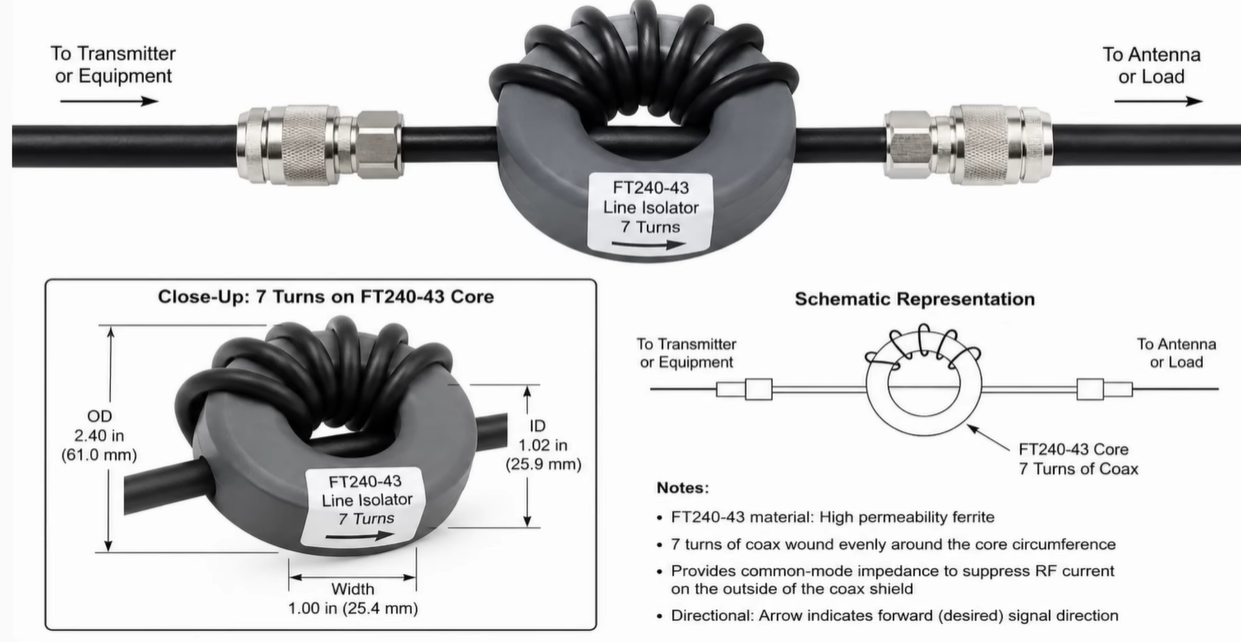
- Use a line isolator at the shack end. This is an important part of keeping the system well behaved.
Is the end-fed half-wave worth using?
For many stations, absolutely.
The EFHW is a practical, beginner-friendly, multiband antenna that gets people on the air quickly. It is simple, reasonably affordable, and easy to install. It also tends to be forgiving from a mechanical point of view. If it comes down, you put it back up. That is a lot less complicated than dealing with large beams, rotators, and all the hardware that comes with more ambitious antenna systems.
Does it have losses? Of course it does.
But so does every real antenna system. And when you look at the actual numbers for a typical installation, the losses in an EFHW are generally modest rather than alarming.
That is the real takeaway. The end-fed half-wave is not magic, but it is not rubbish either. It is simply a useful and effective compromise, and in amateur radio that often turns out to be exactly what you need.
For more information please visit our online store or alternatively contact us and our team will be happy to assist you