
One criticism of the Yaesu FTX-1 Field is that it has no built-in antenna tuning unit. The Icom IC-705 presents much the same problem. These are low-power transceivers, but once you move beyond an antenna that provides a good match on its own, an external matching unit becomes rather useful.
The mAT-1F is designed specifically for the Yaesu FTX-1F. It takes both its power and its control from the transceiver’s accessory socket, and it can feed either a coax-fed antenna or a simple length of wire.
That sounded promising, but I wanted to see how well it actually worked. A quick match on a resonant antenna is one thing. Coping with a non-resonant band, a compact vertical and a makeshift holiday wire is quite another.
Having tried all three, I have to say I’m impressed. This is a capable little matching unit, and its speed is particularly striking. There are, however, some important distinctions between getting a match and getting an efficient antenna system.
Quick Summary
- The mAT-1F is powered and controlled by the Yaesu FTX-1F through its accessory socket.
- Select EXT in the radio’s ATU menu before operating the external tuner.
- Tests produced rapid matches with coax-fed antennas and a temporary end-fed wire.
- A successful antenna match does not establish the efficiency of the complete antenna system.
Table of Contents
- What the mAT-1F Provides
- Connecting the Tuner to the FTX-1F
- First Test: A Coax-Fed End-Fed Half-Wave
- A Good Match Is Not the Same as Good Efficiency
- Second Test: A Compact Garden Vertical
- Third Test: A Makeshift Holiday Wire Antenna
- What the Tests Demonstrated
- My Verdict on the mAT-1F
What the mAT-1F Provides
The mAT-1F is an external automatic antenna tuning unit, or ATU, with a stated maximum power of 10 W. Its specified band coverage runs from 160 m through to 6 m, which is quite a range for a unit intended to accompany a portable transceiver.
That 10 W limit fits the FTX-1 Field’s output when operated from a suitable external DC supply, such as 13.8 V. The important figure for the tuner is the radio’s RF output power, not the voltage of the supply. Keep the RF power within the tuner’s rating.
Two leads are supplied:
- A BNC RF lead connects the tuner to the transceiver’s HF antenna socket.
- A multi-pin control lead connects the tuner to the FTX-1F accessory socket, providing power and control.
There is no internal battery in the mAT-1F. That means there is no separate tuner battery to charge before taking the station away. It does still consume power, of course, but that power comes from the transceiver rather than from another battery inside the matching unit.
The antenna connections are useful, too. Alongside the coax connection are red and black banana sockets for a wire antenna and its earth or counterpoise. You are therefore not restricted to carrying a coax-fed aerial. A length of wire can be connected directly to the tuner.
Connecting the Tuner to the FTX-1F
The physical connection is straightforward. The RF lead goes between the mAT-1F and the HF socket on the back of the radio. The multi-pin lead goes between the tuner and the accessory socket near the bottom of the transceiver’s rear connector panel.
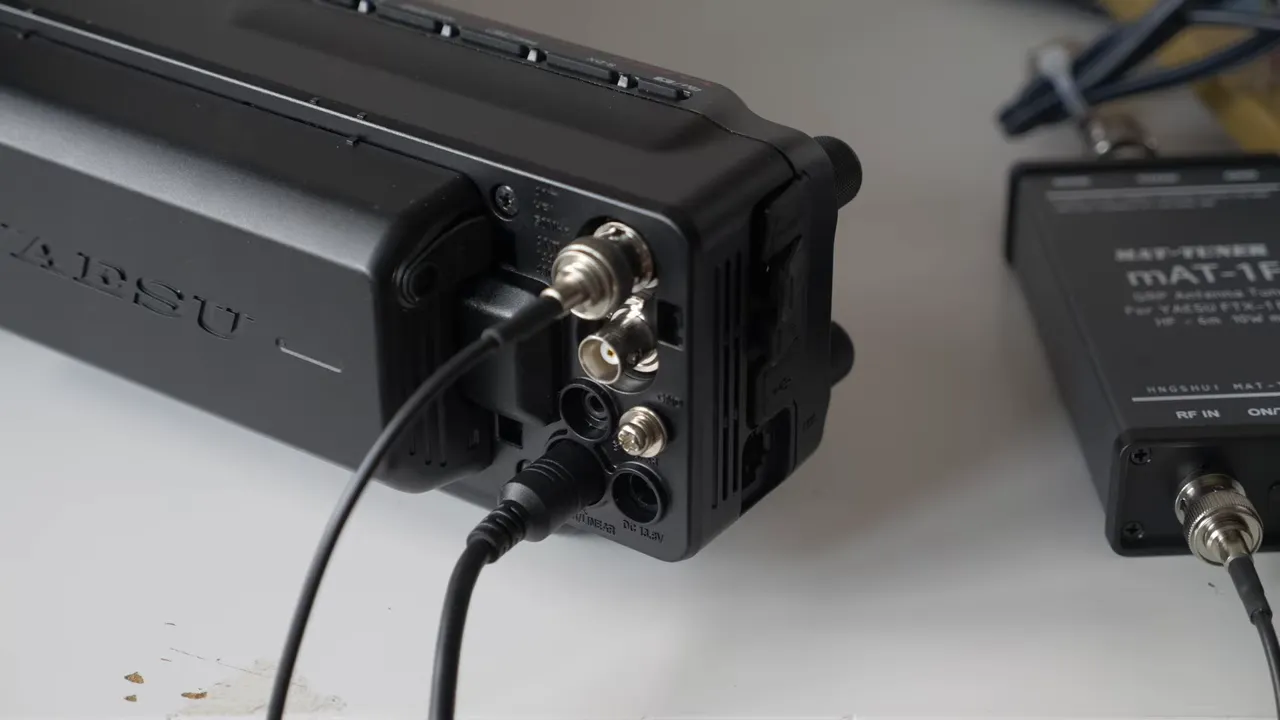
Once those two cables are connected, the radio can supply the tuner and operate it. There is no separate power lead to organise.
However, there is one menu setting that must be changed. Simply plugging in the unit is not the whole setup. The FTX-1F needs to know that it should look for an external ATU rather than the internal tuner arrangement associated with the Optima configuration.
Select the External ATU Setting
The menu route used here is:
- Press and hold the radio’s menu/function button to bring up the menu.
- Select page three.
- Open Operating Settings.
- Scroll down to Options and open it.
- Select the top ATU-related menu item.
- Change its setting from INTERNAL to EXT.
The internal setting is shown as the default. Changing it to EXT tells the transceiver to use the external antenna tuning unit.
With that done, tuning is controlled from the radio itself. You select your frequency and use the transceiver’s tune control. This integration is one of the nicest aspects of the mAT-1F: although the tuner is outside the radio, you do not have to treat it as a separate manually operated accessory.
First Test: A Coax-Fed End-Fed Half-Wave
For the first test, I connected my end-fed half-wave antenna. This antenna is resonant on 40, 20, 15 and 10 m, although its SWR on those bands is approximately 2:1 to 2.5:1. That gives the tuner something useful to correct without starting with an especially difficult load.
I also used the station’s line isolator. Its purpose in this arrangement is to reduce unwanted common-mode RF coming back towards the tuner and transceiver, helping to keep the test setup well behaved.
Starting on 40 m, I pressed the tune control and the match was achieved almost immediately. Moving to 20 m produced much the same result. Then came 15 m and 10 m, and again the unit tuned very quickly.
There was no prolonged wait while the matching unit searched. On these four bands, it was a simple matter of selecting the band, initiating tuning and carrying on.
That is encouraging, but it is worth being clear about what this first test establishes. The antenna was already resonant on those bands. The mAT-1F was correcting a moderate mismatch rather than being asked to deal with a completely unsuitable aerial.
A Harder Test on 17 m and 12 m
The next question was whether it could match the same end-fed half-wave on 17 m and 12 m. This particular antenna is not resonant on either band, so the tuner would have to cope with a more reactive load.
On 17 m, it found a match. On 12 m, it matched as well. I was very pleased with that, because these were more demanding tests than tidying up the SWR on the antenna’s intended bands.
I also noticed behaviour consistent with tuning memory. Returning to a band that had already been matched, the unit appeared ready to go without repeating a lengthy search. I did not investigate the memory’s capacity or its frequency spacing, but the practical result was rapid operation when moving back to previously used bands.
A Good Match Is Not the Same as Good Efficiency
This is probably the most important qualification in the whole exercise: matching an antenna does not prove that it will radiate efficiently.
When the mAT-1F matches the end-fed half-wave on 17 m or 12 m, it presents a suitable load to the transceiver. The radio can then deliver its power into the feed system. That does not tell us how much of that power eventually reaches the antenna and becomes radiated energy.
Losses in the feed system may still be significant. An antenna being used away from its intended resonant bands may also provide limited performance. The tuner has solved the matching problem at the radio, but it has not removed every other limitation in the installation.
I have experimented with using end-fed half-wave antennas on additional bands before, and they can be useful. Sometimes limited performance is quite acceptable, particularly when the alternative is having no antenna available on that band at all.
Nevertheless, keep these two questions separate:
- Can the ATU obtain a match? That is what these tuning tests demonstrate.
- How well does the complete antenna system perform? That requires more than a successful tune indication.
For broader background on antenna systems, the ARRL antenna resources provide a useful starting point. The practical lesson here is simple: use the tuner’s flexibility, but do not mistake it for a guarantee of antenna efficiency.
Second Test: A Compact Garden Vertical
I then tried a compact vertical antenna that I have been experimenting with in the garden. It is approximately 17 to 18 ft high and covers 40 m through to 10 m. That makes it an interesting possibility for a small garden, although its VSWR is not perfect across its operating range.
This is another sensible task for an ATU. You have an antenna intended for several bands, but it still needs some matching assistance rather than presenting an ideal load everywhere.
The mAT-1F matched the vertical on the bands tried from 40 m through to 10 m. For such a modest-height antenna, that was a pleasing result.
I also listened on 40 m and received signals. That confirmed the arrangement was functioning as a receiving station, although it was not a controlled comparison of transmitted signal strength or antenna efficiency.
Afterwards, I realised I had not checked 6 m with this antenna. The tuner obtained a match there as well. There were no signals to hear on 6 m at that moment, so the result was a successful matching test rather than evidence of useful on-air performance on that band.
That distinction matters. A quiet band does not mean the tuner has failed, and a successful match does not mean propagation will provide someone to work.
Third Test: A Makeshift Holiday Wire Antenna
The direct wire connections make the mAT-1F particularly interesting for portable operation. Coax-fed antennas are useful, but sometimes a holiday station consists of little more than a radio on a windowsill and whatever wire you can put outside.
The tuner’s red socket is for the antenna wire. The black socket is for the earth or counterpoise.
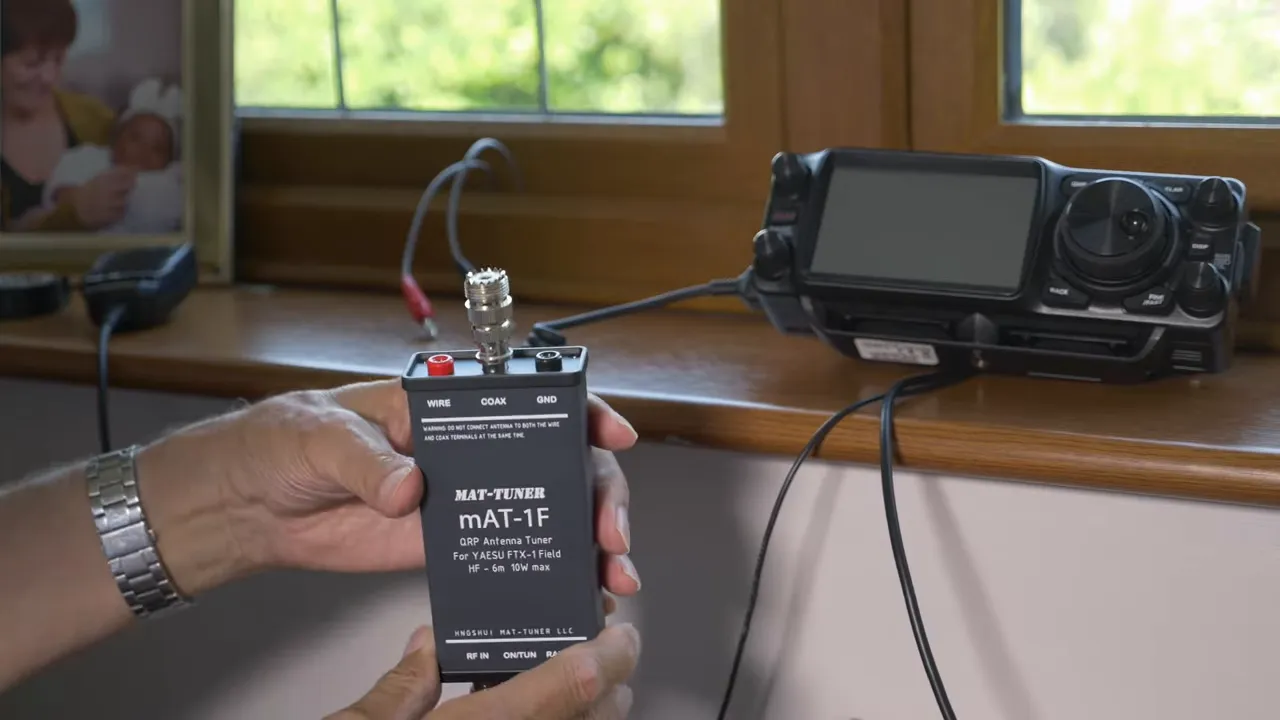
I deliberately put together a rather makeshift installation:
- Approximately 40 ft of antenna wire.
- The wire sloping from an upstairs window down to a shrub.
- An insulator at the far end.
- An 8 ft counterpoise hanging outside the window.
- The FTX-1 Field operating from its battery.
It was certainly not an ideal antenna. That was rather the point. It represented the sort of compromise you might make in a holiday home or hotel, where the available space determines the installation.
With that arrangement, the mAT-1F matched the bands tried from 40 m through to 6 m. It did not obtain a match on 80 m.
I suspect a longer wire would be needed for 80 m in this situation. Something around twice the length would be a sensible next experiment, but I did not establish that as a tested solution. Wire length, counterpoise and the surroundings all form part of the antenna system.
I did not test 160 m. Although it is within the tuner’s stated coverage, that does not mean a short holiday wire will necessarily match there. Like any matching unit, the mAT-1F needs an antenna load within the range it can handle.
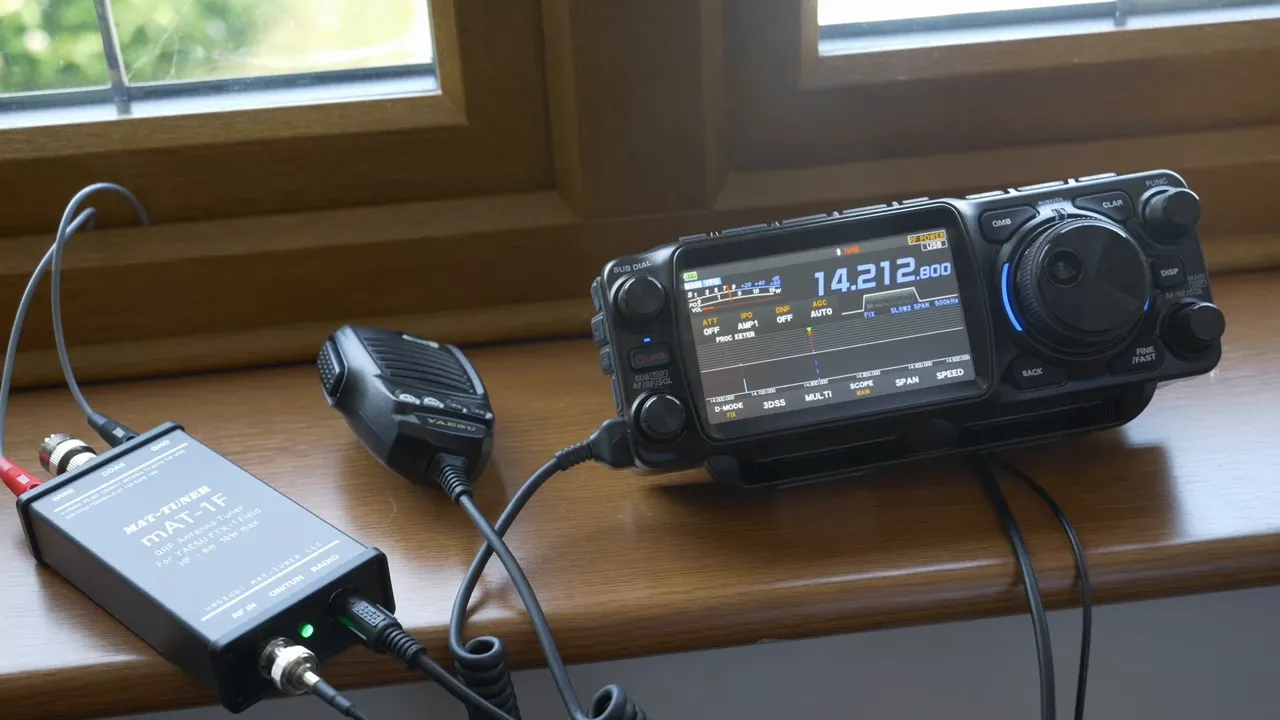
Poor Conditions Complicated the On-Air Check
Band conditions were very poor during this test. On 40 m there were virtually no signals, and checking against the main station aerial showed much the same thing. The band was largely noise rather than activity.
There were some signals elsewhere, including reception on 20 m, so the makeshift wire arrangement did function. What I would not claim is that this brief check establishes its efficiency or predicts the contacts it would make under better conditions.
The useful result is narrower and clearer: the tuner could match a simple temporary wire installation over the bands tried from 40 m to 6 m, with very little fuss.
What the Tests Demonstrated
| Antenna arrangement | Matching result | Important qualification |
|---|---|---|
| End-fed half-wave on its resonant bands | Rapid matches on 40, 20, 15 and 10 m | Starting SWR was approximately 2:1 to 2.5:1 |
| The same antenna on non-resonant bands | Successful matches on 17 and 12 m | Efficiency and feed-system losses were not measured |
| Compact garden vertical | Matched bands tried from 40 to 10 m, plus 6 m | No 6 m signals were received at the time |
| 40 ft wire with an 8 ft counterpoise | Matched bands tried from 40 to 6 m | 80 m did not match; 160 m was not tested |
The standout feature across the tests was speed. Many matches appeared to take less than a second. That is an observation from these installations, not a promise that every antenna on every frequency will tune equally quickly.
My Verdict on the mAT-1F
For an FTX-1 Field owner who needs an ATU, the mAT-1F looks a very good option. It is external, certainly, but the integration makes it convenient: two cables connect it to the radio, the accessory connection supplies its power, and tuning is controlled from the transceiver.
The ability to handle both coax-fed antennas and direct end-fed wire is a considerable advantage. The same unit worked with my station end-fed half-wave, a compact garden vertical and a very improvised holiday-style wire.
Its limitations are sensible ones to remember. Stay within the 10 W rating, select EXT in the radio’s menu, and provide an antenna system the tuner can reasonably match. Do not assume that specified coverage down to 160 m means any short wire will work on the lower bands.
I also found it attractively priced for what it offers. The combination of fast matching, radio control and flexible antenna connections makes it more than just a way of filling the FTX-1F’s missing built-in tuner function.
It does the matching job very well, and it does it quickly. Just remember that the antenna itself still matters. That leaves plenty of scope for experimenting, which is part of the enjoyment of amateur radio.
|
For more information please visit our online store or alternatively contact us and our team will be happy to assist you.