

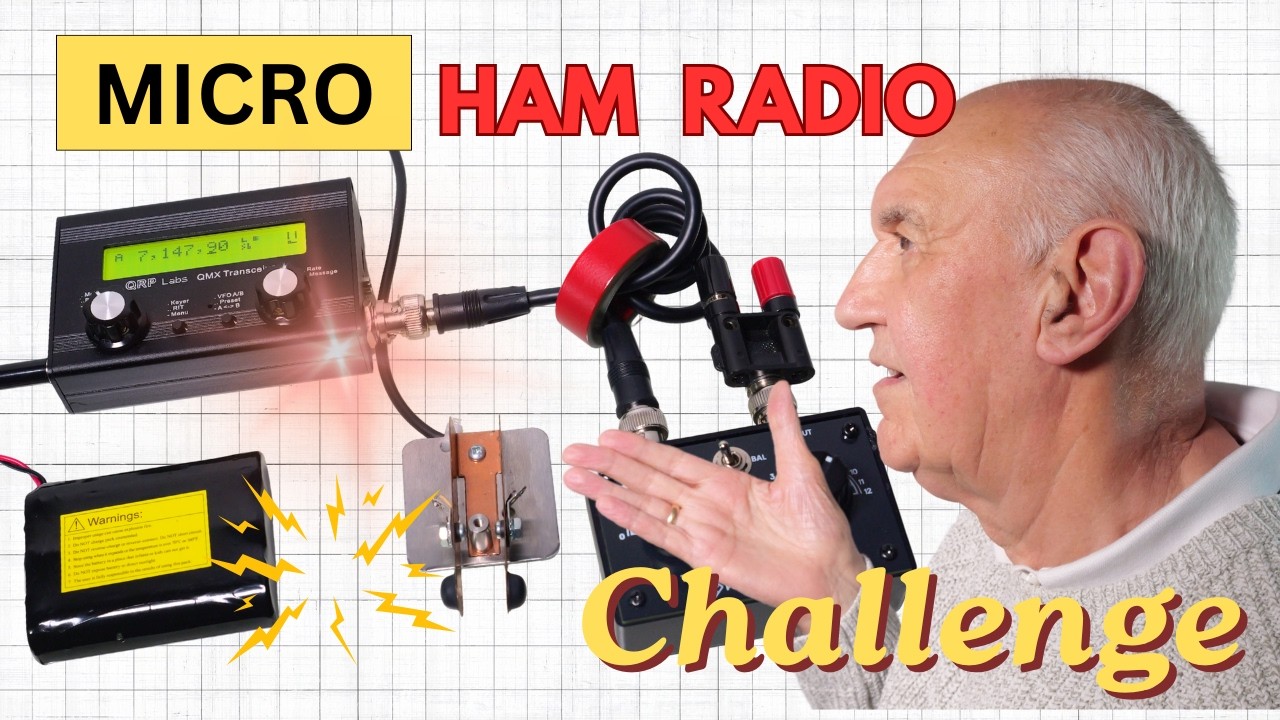
I’ve been experimenting with what I can only describe as a micro QRP station. It feels a bit like a modern-day spy set, only with far better technology and a lot less cloak-and-dagger nonsense. The appeal is obvious: a very compact station, minimal power consumption, quick deployment, and enough capability to make genuine contacts with remarkably simple equipment.
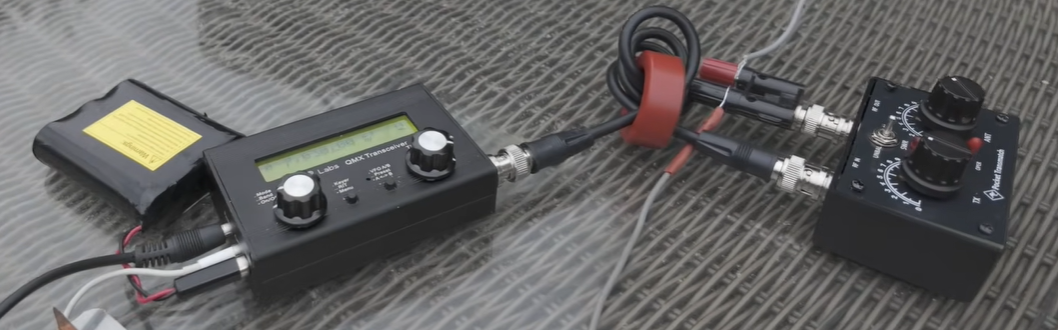
This particular setup was put together in just a few minutes, using a tiny transceiver, a small battery, a compact ATU, a simple Morse paddle, and a very basic wire antenna. It is not a perfect station. It is not even an especially efficient one in this form. But it works, and that is precisely the point.
What makes a micro QRP station so appealing?
There is something very satisfying about reducing a station to the absolute essentials and still getting on the air successfully. With a setup like this, you can operate from the garden, take it portable, or simply enjoy the challenge of making the most of a few watts and a bit of wire.
The idea here is not to build the ultimate field station. It is to show how little you actually need to get a signal out and have some fun on the bands.
The core of the station
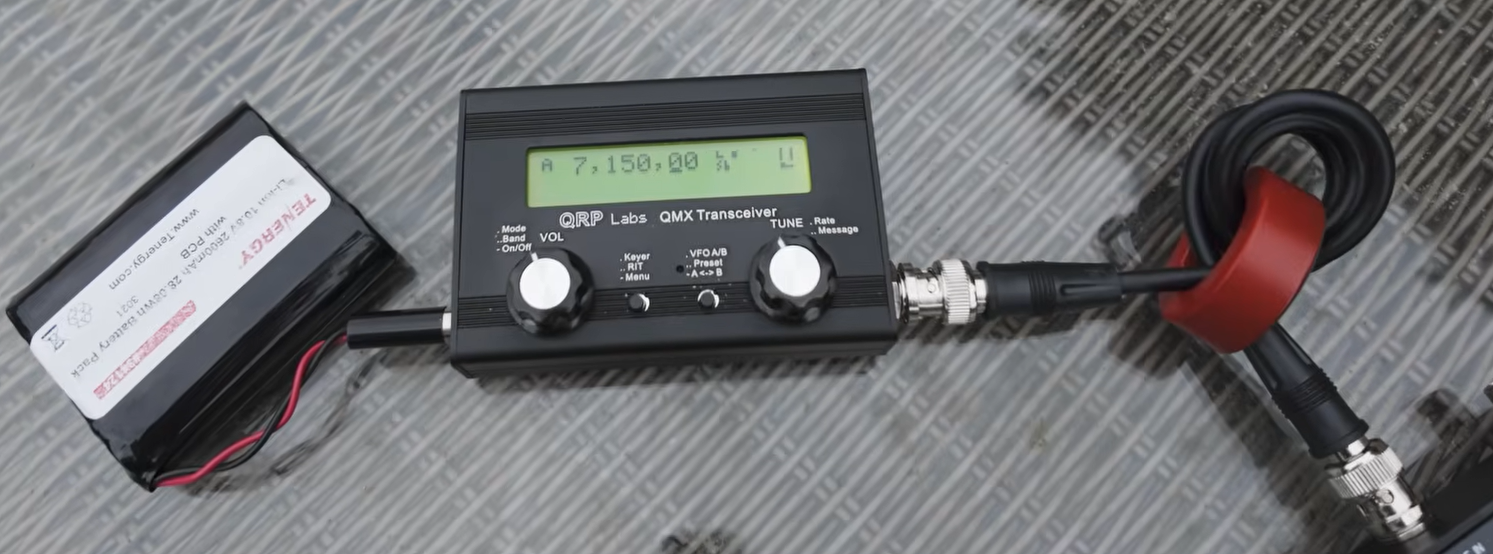
The heart of this micro station is the QMX transceiver. On 40 metres it will give around 5 watts output, although in practice I was seeing about 4 watts on CW. Output varies a bit from band to band, but that is still plenty for QRP operating when conditions are reasonable and the station is matched properly.
The QMX supports both CW and SSB, though I was mainly using it on CW. For keying, I used a tiny MFJ Morse paddle. It is about as simple as a paddle can be, really just sprung metal contacts soldered together, but it works perfectly well.
Power source
For power, I used a small Elecraft battery, roughly 2.8 Ah, delivering about 11.5 volts. That suits the QMX very nicely.
The important point here is that the QMX is extremely frugal. Because it sips current rather than guzzling it, a battery of this size lasts a surprisingly long time. That makes it ideal for portable and casual outdoor operation.
The antenna matching unit
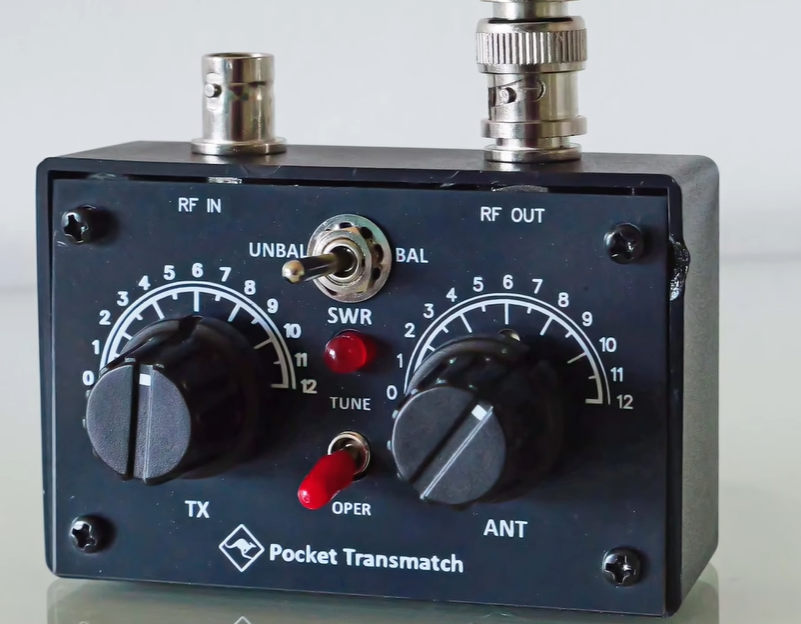
The ATU in this little station is a Kanga kit that I built myself. It is rated at 10 watts and covers 80 metres through to 10 metres. For a compact QRP setup, it is a very useful piece of kit.
What I particularly like about it is that it is:
- Compact
- Simple
- Quick to tune
The tuning method is straightforward. There is a little bridge circuit built into the ATU. When the switch is placed in the tune position, the matching unit becomes part of a bridge, with the antenna forming the missing part of that bridge. You then adjust the two tuning controls until the LED goes out.
Once the LED is extinguished, you switch the ATU to operate. That disconnects the bridge and feeds full power into the antenna. It is not necessarily absolute perfection at that stage, but it gets you very close to the optimum setting very quickly.
Fine-tuning the match with the QMX
This is where the QMX is particularly clever. It includes a VSWR adjustment function in the menu. When selected, the transceiver sends out a continuous low-power signal. The voltage is reduced by 50%, which means the power output drops to roughly a quarter of normal, around 1.5 to 2 watts.
That continuous carrier is extremely useful for tuning. On many transceivers, getting a steady signal out for ATU adjustment is awkward unless you move to another mode. The QMX makes this easy.
With that low-power signal present, you can fine-tune the ATU while watching the VSWR display on the radio. Once the match is optimised, you return to normal operation and the transceiver is ready to deliver full output.
Audio and listening arrangements
For receive audio, I used a pair of old Apple earpieces. They are lightweight, easy to carry, and perfectly adequate for CW work.
I also tried a small rechargeable speaker, an inexpensive unit from Amazon costing about £8.95. Switched over to SSB, the little speaker did surprisingly well. The QMX receiver itself is impressive. Audio is clear, and the overall receive performance from such a small transceiver is very good indeed.
One small but important addition: ferrite on the lead
One thing I found quickly was that the setup needed a little help with RF suppression. There was some RF getting back into the transceiver, which is not unusual with compact portable stations and very simple antennas.
The cure was simple: a ferrite ring on the lead with three turns through it. I happened to have the ferrite core lying on the bench, and once fitted, it cured the problem completely.
It is a small detail, but with a minimal station like this, these little practical fixes can make all the difference.
The antenna: as simple as it gets
The antenna system is about as basic as you can make it. There is no elaborate design, no precision measurement, and no claim that it is the most efficient thing in the world.
It consists of:
- A random wire of about 7 metres
- A second length of wire on the ground acting as a counterpoise
That is really all there is to it.
The wire was run from the operating table into a nearby fig tree, draped over a fence, and taken down to a shrub. It was a very hastily erected antenna system, and there is no great science in it at all. One wire is the aerial, the other wire is the counterpoise, and that was enough to get on the air.
This is worth stressing because it proves an important point: you can set up a workable station extremely quickly with very little equipment. It may not be the most efficient arrangement possible, but it is still capable of real contacts.
Real-world result: a contact into Belgium
Even with this improvised antenna, the station performed well enough to make a proper CW contact with ON3FLD in Belgium. He came straight back to my call and gave me a signal report of 359.
That is not bad at all, considering the antenna was just two bits of wire thrown together in short order. We had a QSO of around five minutes, exchanging the usual details such as:
- Name
- Location
- Weather
- Signal reports
That sort of result is what makes QRP so enjoyable. You do not need a towering mast and a full legal-limit station to have a satisfying contact. A few watts and a bit of ingenuity can go a long way.
Why the QMX is especially interesting on SSB
Although I was mainly using CW, the QMX has another notable advantage on sideband. It uses controlled-envelope SSB, often shortened to CE SSB. In practical terms, this can make the transmitted SSB signal sound around 3 dB or a little more stronger than a normal transceiver at the same nominal power level.
That is quite impressive in such a small radio. It means the QMX is not merely a tiny compromise box. It is actually rather advanced.
Polar modulation and efficiency
The QMX also uses polar modulation, which contributes to the efficiency of the power amplifier. The PA is very frugal because it only really draws current when there is actual speech present. If there is no speech, it effectively draws no current at all in the transmit chain.
That makes it more like a switching PA than a traditional arrangement, yet without the distortion problems you might normally expect from non-linear operation, because of the way the polar modulation system works.
It is a very interesting area of radio design, and one that may become more common in future equipment. The implication is clear enough: more efficient transmitters, smaller heat sinks, and better battery life. It would not be surprising to see larger manufacturers adopt similar ideas more widely in the years ahead.
The complete micro QRP station at a glance
If you wanted to build a similar station, the basic ingredients are very simple:
- QMX transceiver
- Small 11 to 12 volt battery
- Compact ATU, such as the Kanga kit
- Morse paddle or microphone, depending on mode
- Earpieces or a small speaker
- Ferrite choke if RF finds its way back into the rig
- Simple wire antenna and counterpoise
That really is enough to create a compact portable ham radio station that can be deployed in minutes.
Practical takeaways
A few things stood out clearly from using this setup:
- Simplicity works. You do not need a complicated station to enjoy amateur radio.
- The antenna matters, but perfection is not required. Even a very rough wire arrangement can produce usable results.
- An efficient transceiver transforms portable operating. The QMX makes excellent use of a small battery.
- A good ATU is invaluable. Quick and easy matching turns random wire into a practical antenna system.
- Small RF issues are manageable. A ferrite choke can solve a lot of grief in compact stations.
Final thoughts
I came away very impressed with this little station. It is great fun to use, quick to set up, and perfectly capable of making genuine contacts. With a better antenna, it would naturally perform better still, but even in this very basic form it demonstrates what a micro ham radio QRP station can do.
If the idea appeals, the QMX from QRP Labs is well worth a look. It is available as a kit, and if you want one ready-built there is usually a waiting list, which tells you something about how popular it has become. It is also very reasonably priced for what it offers.
For anyone tempted by compact portable operation, garden operating, or simply the pleasure of making the most of minimal gear, this sort of setup is hard to beat. A small radio, a small battery, an ATU, two bits of wire, and a bit of patience can still deliver a surprising amount of amateur radio enjoyment.
For more information please visit our online store or alternatively contact us and our team will be happy to assist you.
Credits: Peter Waters (G3 OJV)