

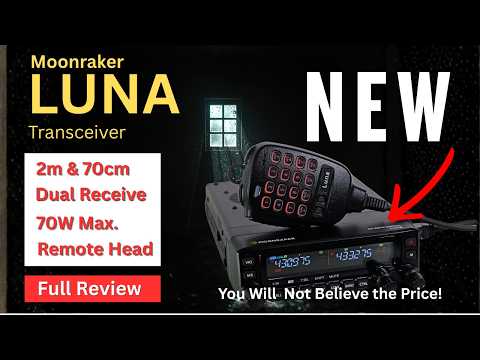
The Moonraker Luna is one of those radios that grabs attention for two very simple reasons. First, it is genuinely feature-packed. Second, it comes in at a price that makes you look twice.
This is a dual band mobile transceiver covering 2 metres and 70 centimetres, with dual receive, a detachable head, VHF airband receive, and even FM broadcast reception if you just want something on in the background. For a set costing under £200, that is a lot of radio.
After spending some time with it, the Luna comes across as a very practical rig. It is straightforward to use, sensibly laid out, and includes a few touches that are genuinely useful in everyday operation.
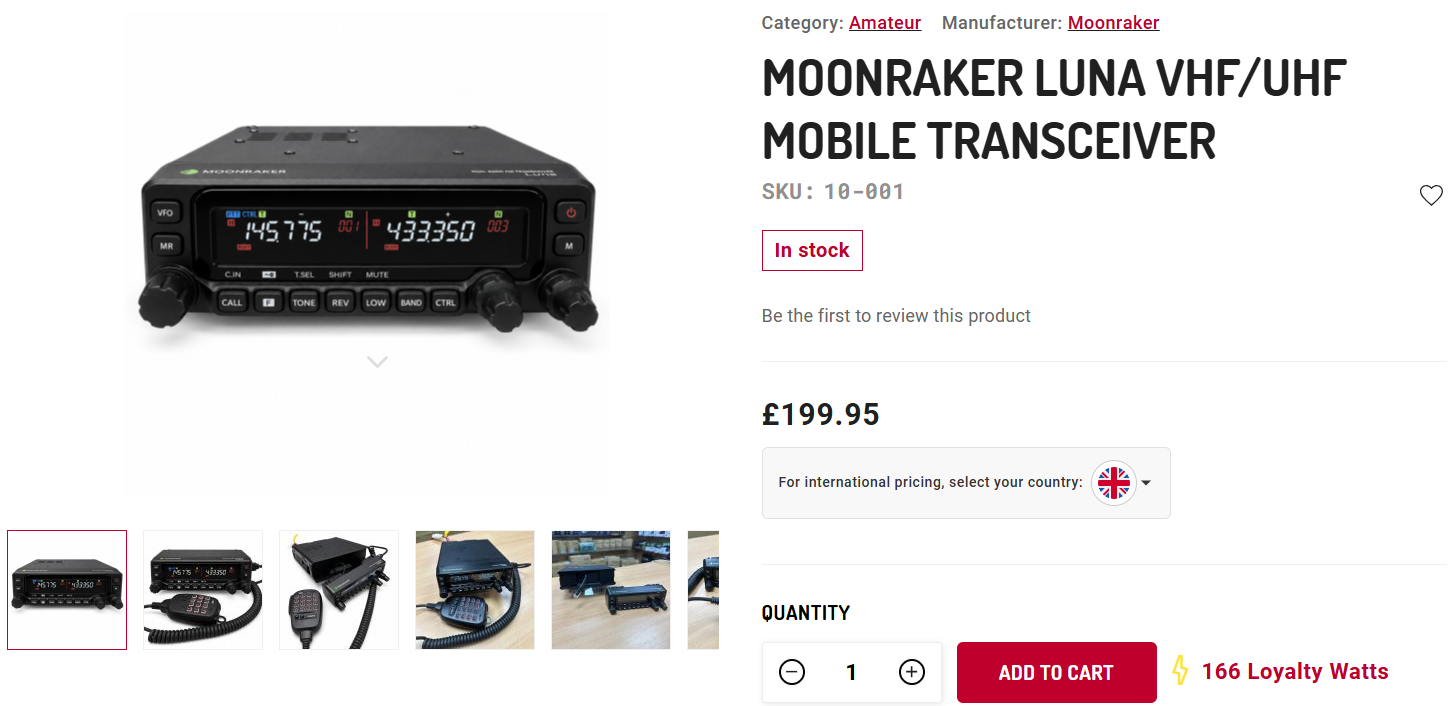
What the Moonraker Luna offers
At its core, the Luna is a mobile dual band transceiver with coverage on:
- 2m
- 70cm
Moonraker rates it at up to 70 watts on 2m and 50 watts on 70cm, although the front panel power setting descriptions suggest high power modes of around 75 watts on 2m and 60 watts on 70cm. In practical testing, the output looked to be about 70 watts on 2m and 50 watts on 70cm, which is still very respectable for a radio at this price point.
Physically, it is built as a mobile set with:
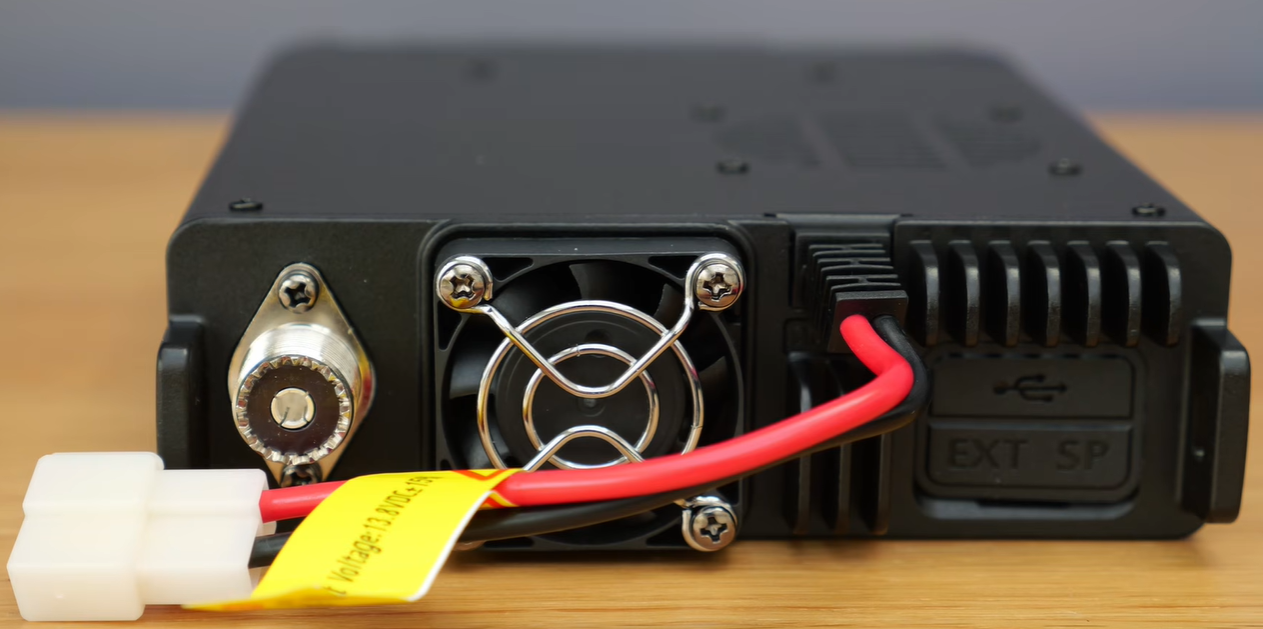
- A single SO-239 antenna connector
- A cooling fan
- A generous heat sink
- An upward-facing speaker in the top panel
- Two external speaker connections on the rear
- A USB-C socket for programming
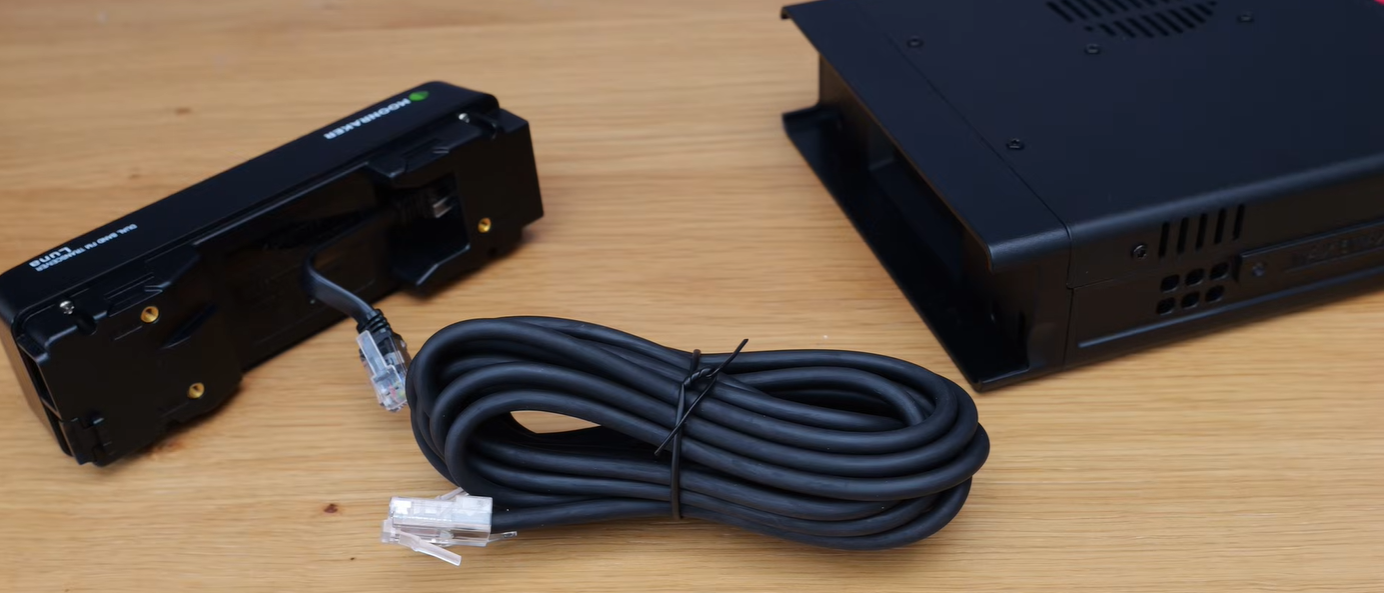
One nice touch is that the radio has microphone sockets on both sides of the main unit. That is there to support one of the set’s most useful features: the detachable front panel.
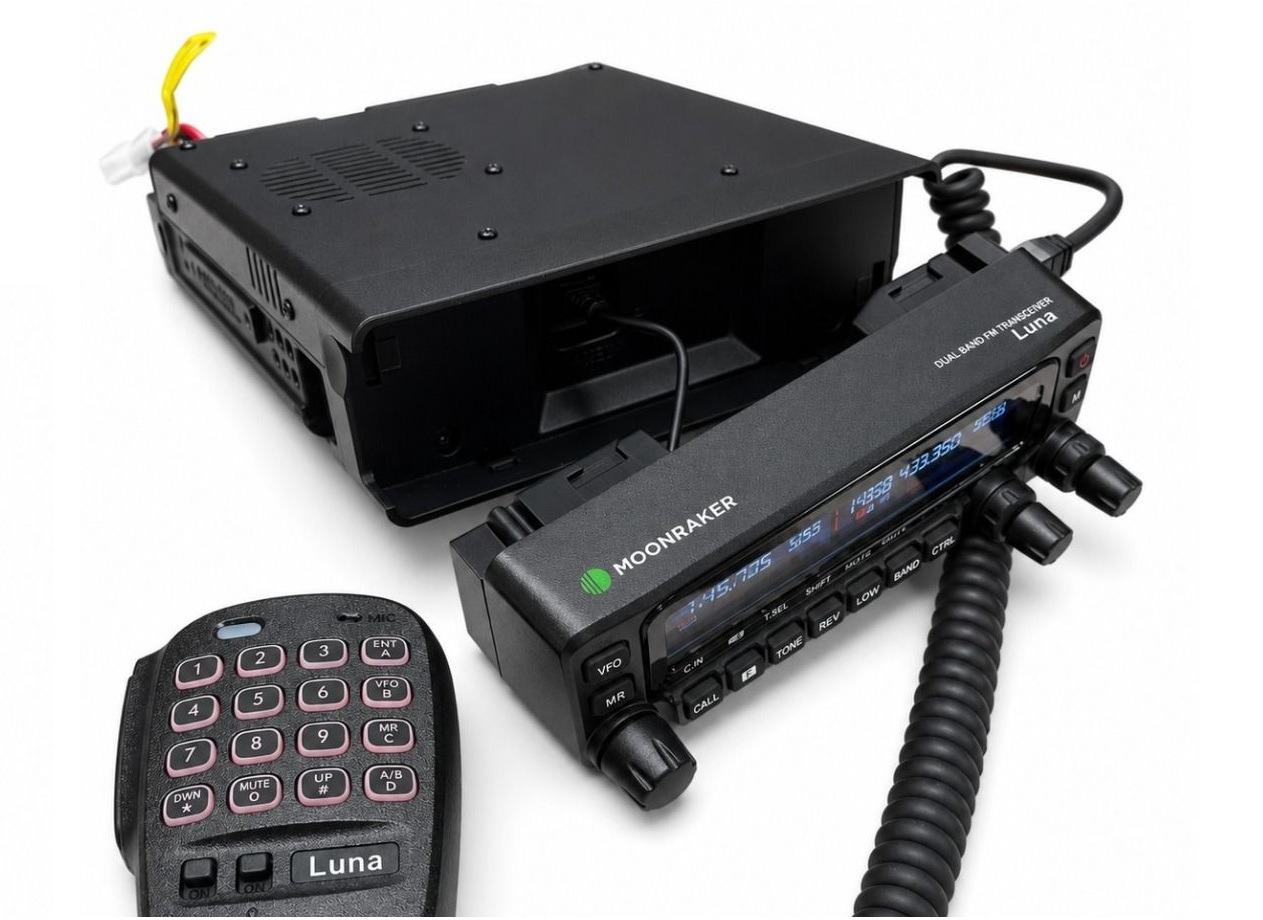
Detachable head with extension cable included
The detachable head is not unusual in itself, but what is refreshing here is that Moonraker has included a 4-metre extension cable in the box at no extra cost.
That matters because detachable control heads are most useful when you can actually position them where you want. In many installations, particularly in modern vehicles where dashboard space is limited, the separation kit is what turns a mobile set from awkward to genuinely installable.
Including the cable as standard makes the package feel complete rather than stripped back.
Dual receive that is genuinely useful
One of the headline features of the Luna is dual receive. In plain terms, that means you can monitor two channels at the same time.
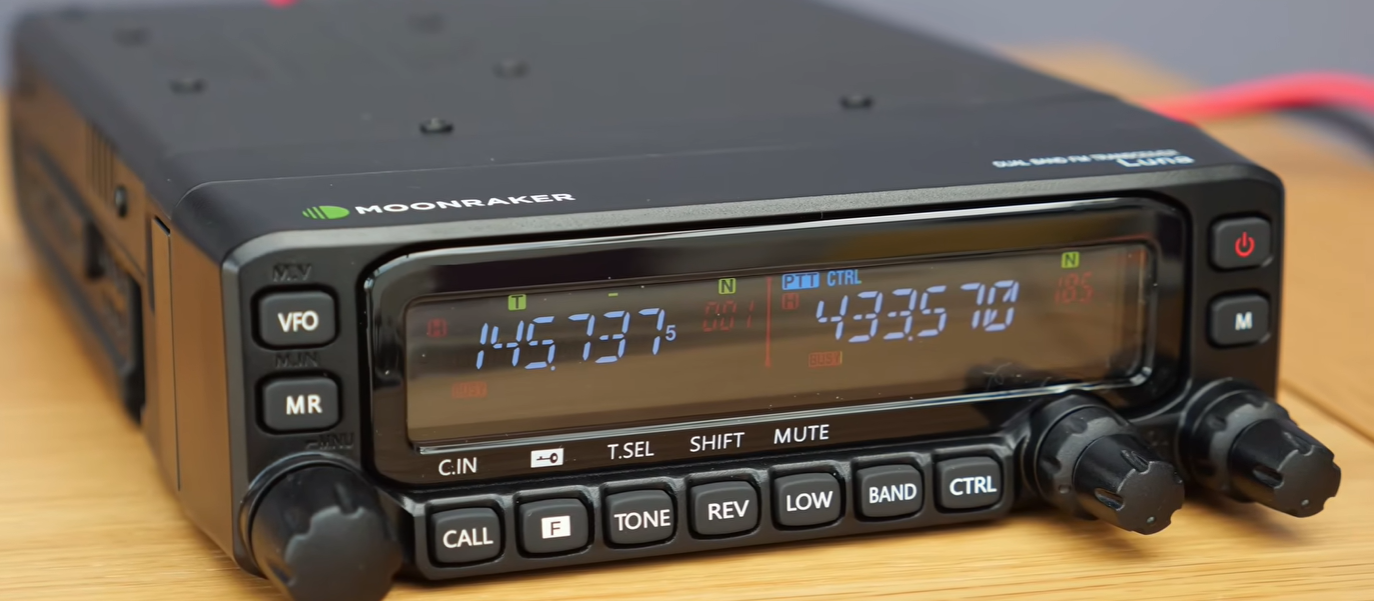
The front panel is arranged to make this easy to manage. You get separate volume controls for left and right, along with corresponding squelch controls. So, if you are monitoring one frequency on 2m and another on 70cm, each side can be adjusted independently.
That alone makes the set far more versatile than a basic single-receive mobile rig. You can, for example:
- Monitor a local 2m repeater while keeping an ear on a 70cm simplex frequency
- Listen to one active calling channel while scanning or monitoring another
- Split your attention between amateur band activity and airband
There is another useful wrinkle here too. The Luna does not force you into one band per side. You can also put the same band on both sides.
That means you could monitor:
- Two different 2m frequencies at once, or
- Two different 70cm frequencies at once
That is a small detail, but it gives the radio a lot more flexibility in day-to-day use.
Front panel controls and basic operation
The general operation is fairly straightforward.
The main power button is on the top right. Press and hold it to switch the radio on, and do the same to switch it off.
The VFO control handles frequency changes, and you can select which side of the display you are adjusting by pressing the relevant control. So if the left side is showing 70cm and the right side is showing 2m, you simply choose the side you want and tune that independently.
That makes the radio quick to get around without feeling buried in menus.
The menu system is simple and sensible
The Luna’s menu system is not complicated, which is exactly how many operators like it.
To get into the menu, you:
- Press the function button
- Press the tune button
- Select and adjust the setting using the tuning control
For something like changing the tuning step, it is a quick process. Select the menu item, rotate to the value you want, confirm it, and you are done.
Tone settings are handled separately. To set up things like DCS or DTMF, you first press the tone button and then the function button, which opens access to those options.
Nothing about the interface suggests a steep learning curve. In fact, one of the more pleasant surprises is that the user manual is actually well written. It gives enough information to get up and running without the usual frustration of trying to decode vague menu descriptions.
Power levels and what they actually measured
The radio offers three power settings:
- Low
- Medium
- High
From the front panel operation:
- Low power is labelled as 5 watts
- Medium power is 20 watts on both bands
- High power is presented as around 75 watts on 2m and 60 watts on 70cm
In actual use, the measured output was a little different.
Measured output on 2m
- High: about 70 watts
- Medium: about 20 watts
- Low: closer to 10 watts than 5 watts
Measured output on 70cm
- High: about 50 watts
- Medium: about 20 watts
- Low: again closer to 10 watts than 5 watts
That low power figure being nearer 10 watts is unlikely to trouble many people. In fact, 10 watts is often a very usable “low” setting for mobile and local work.
Airband receive is a standout extra
One of the Luna’s most interesting features is the inclusion of VHF airband receive.
This is not just a token addition. The sensitivity seemed quite respectable in practice. Reception from Stansted Approach was possible from around 35 to 40 miles away, which suggests the receiver is doing a decent job.
Better still, airband can be used alongside the amateur bands thanks to the dual receive capability. So you can listen to:
- Airband on one side
- 2m or 70cm on the other
That gives the set appeal beyond straightforward amateur operation, especially for anyone who enjoys monitoring local aviation activity as well.
There is one limitation to be aware of, though. The tuning range on airband appears to run from 108 MHz to 135.995 or 136 MHz, rather than extending all the way to 137 MHz. So the very top slice of the band is missing at present.
For many people that will not matter much, but it does mean some services near the top end of the VHF airband fall outside coverage. It is the sort of thing that could potentially be addressed in a future firmware update.
FM broadcast receive is included too
If amateur activity is quiet and airband is not of interest at the time, the Luna also lets you receive the FM broadcast band.
That is obviously not the main reason to buy a transceiver, but it is a handy extra. It rounds out the radio’s role as a general-purpose mobile communications set rather than a narrowly focused amateur-only box.
The keypad microphone adds proper control
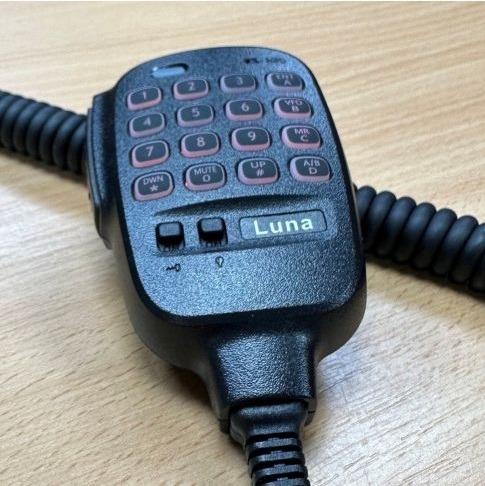
The supplied microphone is a keypad mic, and it gives good access to the radio’s main functions.
It includes:
- The usual up/down controls on the top
- A PTT button on the side
- A hanging hook on the rear
That all sounds standard enough, but it means the radio feels complete straight out of the box. You are not dealing with a stripped-down hand mic that leaves you reaching for the front panel for every basic task.
A couple of practical operating touches
Two smaller details stood out during use.
First, normal tuning is done in the currently selected channel step, but if you briefly press the tuning control, the radio can jump in 1 MHz steps. That makes it much quicker to move around the band when you want to QSY rather than crawl along in 12.5 kHz or 25 kHz increments.
Second, as already mentioned, the dual receive arrangement is flexible enough to let you monitor either two different bands or two frequencies on the same band. That gives the Luna a practical edge for anyone who likes keeping tabs on more than one local frequency at a time.
On-air performance
Actual contacts on 2 metres showed the radio working well, particularly at the higher power setting. There was nothing in use to suggest the Luna is merely a feature-sheet radio. It behaved like a competent, usable mobile set.
That is important because with budget-priced transceivers, the temptation is always to focus on the specification list. Features are nice, but if the radio is awkward to operate or poor on air, the novelty wears off quickly. The Luna does not appear to fall into that trap.
Who is the Moonraker Luna for?
The Luna makes a strong case for several types of operator.
- Newcomers who want a first mobile dual band transceiver without spending a fortune
- Mobile operators who will benefit from the detachable head and included extension lead
- Regular VHF/UHF users who want dual receive at a sensible price
- Operators with an interest in airband who like having extra listening options in one box
It is particularly appealing because it combines genuinely useful features with straightforward operation. You do not need to wrestle with it to get value out of it.
Final thoughts
The Moonraker Luna is a very practical radio and, at under £200, it is also very easy to recommend.
You are getting:
- 2m and 70cm coverage
- Dual receive
- The ability to monitor two frequencies on the same band
- Up to 70 watts on 2m and around 50 watts on 70cm in real use
- Airband receive
- FM broadcast receive
- A detachable head
- An extension cable included in the package
- A decent display and straightforward controls
No radio is perfect, and the missing top end of the airband coverage is worth noting. Low power also appears to be nearer 10 watts than 5 watts. But neither point really undermines what this set gets right.
For the money, the Moonraker Luna offers an impressive amount of functionality in a package that feels thought through. If you want an affordable dual band dual receive transceiver for 2m and 70cm, this one is well worth serious consideration.
For more information please visit our online store or alternatively contact us and our team will be happy to assist you.