


The Moonraker SWR 777 is not just another SWR meter with a digital screen bolted on the front. It does the usual jobs you would expect from a VSWR and power meter, but it also adds a few genuinely useful touches that make it rather more interesting than the average station accessory.
The headline feature is its ability to show not only forward power and VSWR, but also how much power is effectively being lost because of mismatch. That is the sort of information most of us tend to estimate mentally, if we think about it at all. Here, the meter does the calculation for you.
It is also self-powered from an internal rechargeable battery, has a full colour display, selectable screens, warning LEDs, an audible high VSWR alarm, and even user calibration adjustment for power and SWR. For a compact meter, that is quite a lot packed into one box.
What the SWR 777 covers
According to the box, the Moonraker SWR 777 covers 1.8 to 250 MHz, which takes in everything from 160 metres up to 2 metres. For many amateur stations, that means one meter can handle a large chunk of day-to-day operating.
The quoted figures are:
- Frequency range: 1.8 to 250 MHz
- VSWR accuracy: ±5%
- Power reading accuracy: ±10%
- Internal battery: 1000 mAh rechargeable
That level of accuracy is typical for this sort of meter. It is not pretending to be a laboratory instrument, but for practical amateur use it is in the right ballpark.
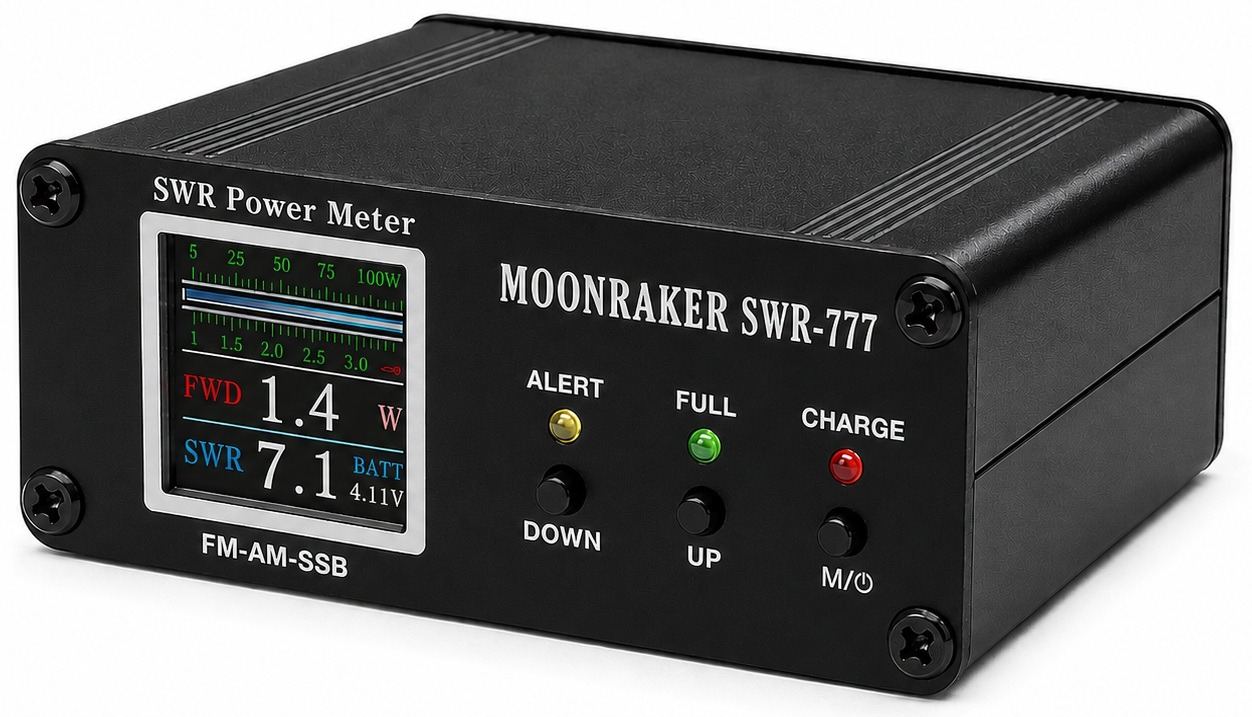
Physical layout and first impressions
On the front, you get a colour display along with three status legends on the left:
- Alert
- Full
- Charge
Beneath those are three LEDs, which act as a quick visual guide to your SWR condition. At the bottom are the control buttons: up, down, and a multifunction button that also handles on and off duties.
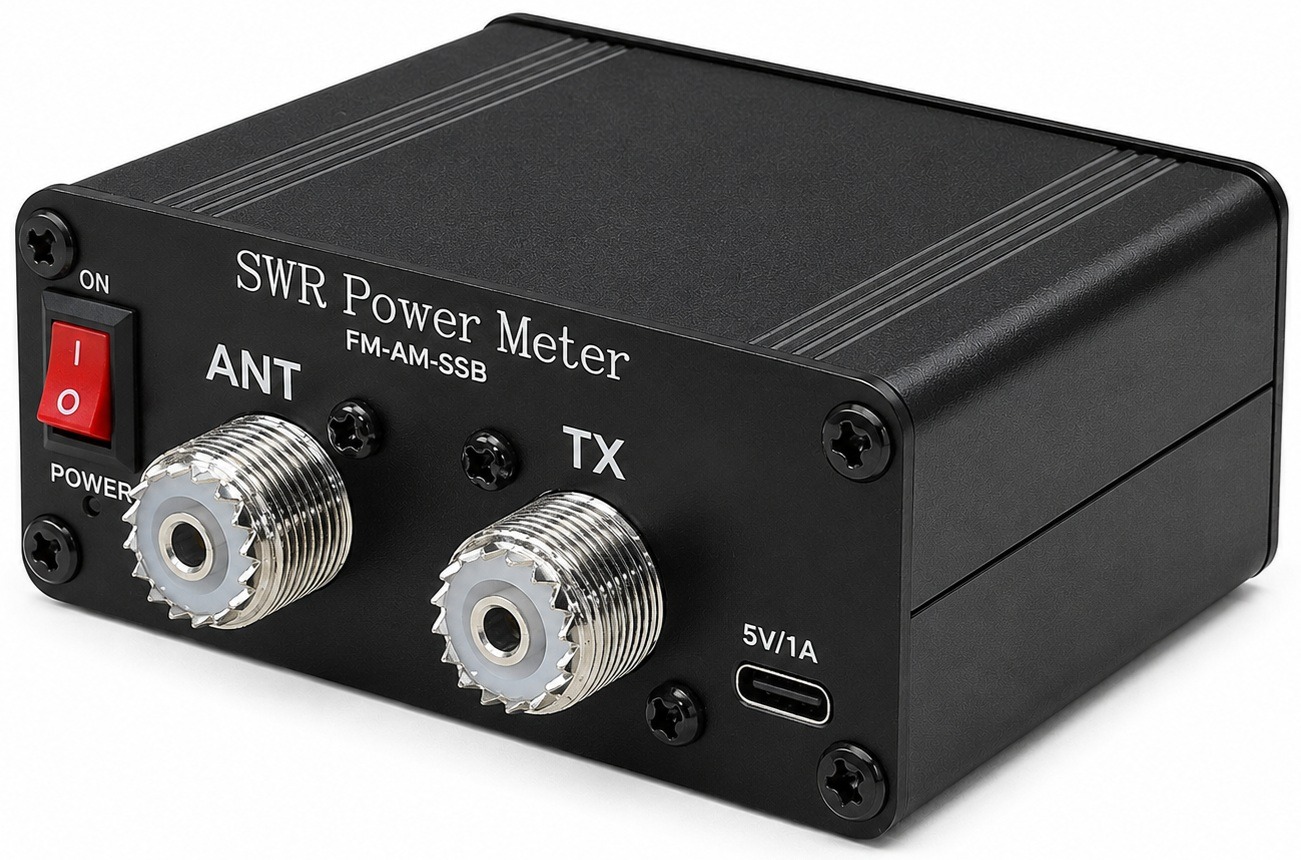
Round the back are the expected SO-239 sockets, one for the transceiver and one for the antenna, along with a master power switch and a USB-C socket for charging.
The built-in rechargeable battery is one of the handiest parts of the design. There is no need to find an external DC lead just to use the meter. For portable use, temporary test setups, or simply keeping the shack tidy, that makes life easier.
A digital meter that is easy to live with
Once powered up, the display takes a couple of seconds to come to life. From there, operation is straightforward, and the screen is much more informative than a basic analogue cross-needle meter.
To check basic power accuracy, the meter was used with a Yaesu transceiver set to FM at 10 watts into a dummy load. FM is ideal for this sort of test because it gives a steady carrier.
The result was exactly what you would hope for. The transceiver was set for 10 watts and the SWR 777 was reading 9.9 to 10 watts into a 1:1 VSWR. In practical terms, that is spot on.
That immediately gives confidence that the unit is doing the basics properly. A meter can have all the clever display options in the world, but if it cannot read ordinary forward power sensibly, none of the extras matter.
The most interesting feature: power loss calculation
This is where the Moonraker SWR 777 starts to stand out.
One of the display screens shows two key figures:
- Forward Power
- Antenna Power
At first glance, that second reading can be a bit puzzling. If the meter is in the feedline, how can it possibly know what power is arriving at the antenna?
Strictly speaking, it cannot know the total power at the antenna terminals because it has no idea how much coax you are using or what the feedline loss is. What it can do is calculate how much power is being lost as a result of the VSWR mismatch, and then show the net power being delivered after taking that mismatch loss into account.
That makes the display very useful in real operating terms. Instead of simply seeing a less-than-ideal SWR number and wondering how much it matters, you can see the actual effect in watts.
-
 RG58 Standard (50 OHM) CoaxAs low as £0.45
 -
 RG58 Mil Spec (50 OHM) CoaxAs low as £0.60
 -
 Mini8 Mil Spec (50 OHM) CoaxAs low as £0.90
 -
 RG174 Mil Spec (50 Ohm) Super Thin CoaxAs low as £0.50
 -
 SSB - Aircell 5 (Low Loss Coax) (5mm)As low as £2.75
 -
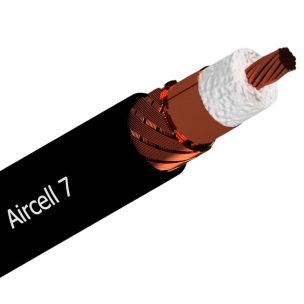 SSB - Aircell 7 (Low Loss Coax) (7mm)As low as £3.95
 -
 M&P - Airborne 5 CoaxAs low as £1.35
 -
 M&P - POTA-FLEX 7 CableAs low as £4.50
Product Carousel: Feedline Options Worth Considering for Your Shack - 3, 5, 7 mm
-
 RG213 Mil Spec (50 OHM) CoaxAs low as £1.75
 -
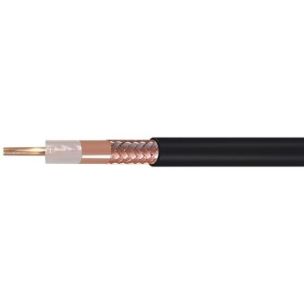 Formula Zero Mil Spec (50 OHM) CoaxAs low as £2.00
 -
 FZ400CU (LMR400) Super Low Loss CoaxAs low as £2.25
 -
 SSB - Ecoflex 10 (Low Loss Coax) (10mm)As low as £5.25
 -
 SSB - Ecoflex 15 (Low Loss Coax) (15mm)As low as £8.95
 -
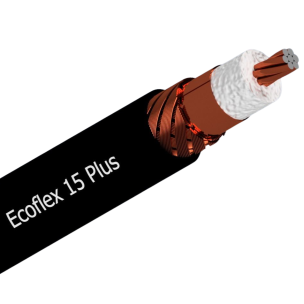 SSB - Ecoflex 15 PLus (Low Loss Coax) (15mm)As low as £10.95
 -
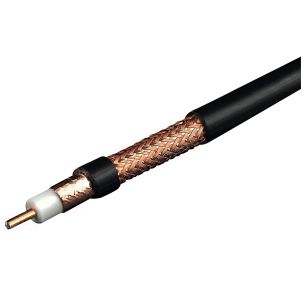 M&P - Broad-Pro 50c CoaxAs low as £4.25
 -
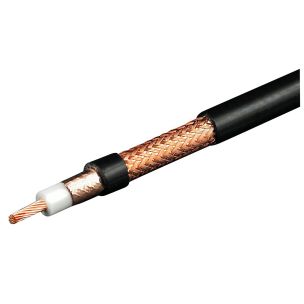 M&P - Ultraflex 10C (Competition) CoaxAs low as £3.50
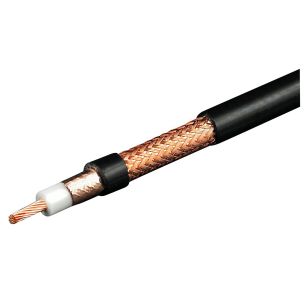
Product Carousel: Feedline Options Worth Considering for Your Shack - 9, 10, 14 mm
Real-world example with a poor 20-metre antenna
To demonstrate the point, the meter was connected to a fairly poor antenna on 20 metres. The readings were:
- Forward power: 22.9 W
- VSWR: 2.6:1
- Reflected power: 4.5 W
- Antenna power: 18.4 W
- Efficiency: 81%
That tells a much fuller story than a conventional meter. You are not just looking at a 2.6:1 mismatch and thinking, “That is not great.” You can immediately see that with roughly 23 watts going forward, only around 18.4 watts is being delivered once the mismatch loss is taken into account.
The efficiency figure is another nice touch. In this case, the display shows 81%, which makes it very easy to understand the practical effect of the mismatch without having to do any mental arithmetic.
For antenna testing, quick comparisons, or simply deciding whether an SWR issue is serious enough to worry about, this is genuinely useful information.
Multiple display screens
The SWR 777 includes several display screens that you can cycle through using the front-panel button. The basic screen gives you the sort of layout most operators will find familiar, with horizontal bar indications for forward power and VSWR, backed up by large digital figures.
That combination works well. You get the quick visual impression from the bars, and the precise reading from the numbers.
The extra screens provide alternative ways of viewing the data, including the more detailed power-loss and efficiency information. Rather than being stuck with a single display mode, you can use the one that suits what you are doing at the time.
User calibration adjustment
Another surprisingly thoughtful feature is the ability to correct the meter if you want it to track more closely against a reference standard.
By holding the relevant button during startup, you can enter an adjustment mode for:
- Forward power correction
- VSWR correction
The adjustment is linear, so you are effectively trimming the scale across the range. If, for example, the unit reads slightly high or slightly low compared with a trusted reference, you can nudge it into line and save that correction in memory.
In use, the sample tested was reading a little high on power. It was still within the stated ±10% tolerance, but it was adjusted to match a Bird thruline, which is a very reliable reference. Once corrected, the reading aligned exactly as desired.
That is a very nice option to have. Most meters at this end of the market do not give the user any practical means of calibration adjustment.
-
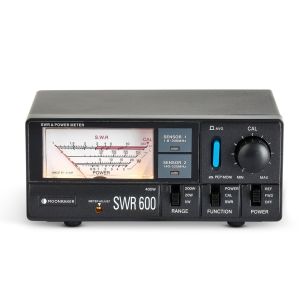 Moonraker SWR-600 (1.8-525 MHz 400W) VSWR Power MeterSpecial Price £79.95 Regular Price £84.95
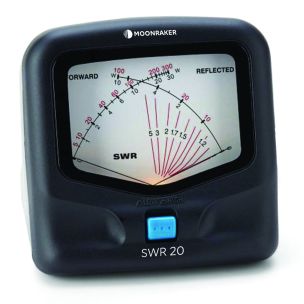
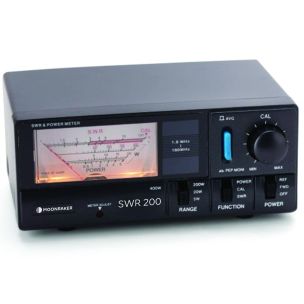


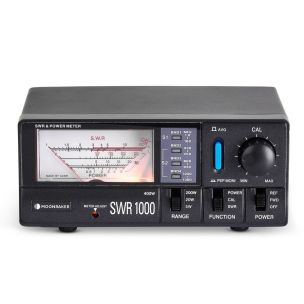

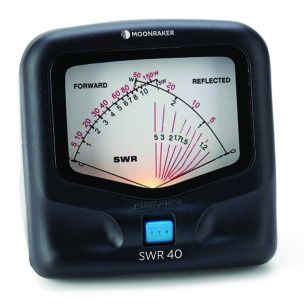
Product Carousel: Popular Moonraker SWR & Power Meters for Amateur Radio
LED SWR indication at a glance
The three LEDs on the front panel are simple, but very effective. They give you an instant visual indication of how healthy the match is:
- Left LED: VSWR below 1.5:1
- Middle LED: VSWR between 1.5:1 and 2.5:1
- Right red LED: VSWR above 2.5:1
This means you do not always need to stare at the exact numbers. A quick glance is enough to tell whether things are fine, borderline, or poor.
Audible high VSWR alarm
The audible warning feature is another practical addition. If your SWR suddenly goes high and you are not looking directly at the meter, an alarm can sound to get your attention.
That may seem a small thing, but in normal shack use it is quite sensible. If an antenna fault develops, a plug works loose, or something changes unexpectedly, a warning tone is far better than relying on noticing a tiny LED at the edge of your vision.
The alarm can be enabled or disabled with a brief press of the button, so you are not forced to use it if you prefer silence.
Battery operation and auto shut-off
Because the SWR 777 has its own rechargeable battery, it is not drawing from an external supply during normal use. That alone makes it convenient.
It also has an adjustable display timeout. By holding the relevant button for a couple of seconds, you can set how long the display remains active before switching itself off.
Better still, if the main rear power switch is still on, the meter can wake the display back up automatically when RF power is applied from the transceiver. So if you leave it sitting there and forget about it, the current drain in standby is extremely low, and the unit springs back into life when needed.
In ordinary use, of course, you would still switch it off fully with the rear master switch, but the standby behaviour is well thought out.
An important note about the power rating
There is one small anomaly worth mentioning.
The packaging states 210 watts, but the actual specification appears to rate the unit at 110 watts. In practice, the issue seems to be that the display only reads up to about 110 watts rather than that the meter would necessarily be physically damaged by a higher power level such as 200 watts.
Even so, the sensible conclusion is this:
- If you are using a typical 100-watt HF transceiver, this meter should suit you very well.
- If you are using a linear amplifier, this is not really the meter for measuring the amplifier’s full output power.
That said, many linear amplifiers have their own metering anyway. A practical arrangement is to place the SWR 777 in line with the HF transceiver feed to the linear. With the amplifier off, you get an accurate reading of what is going forward. With the amplifier on, the linear’s own meter can indicate the higher output power.
Where the Moonraker SWR 777 fits best
This meter makes most sense for operators who want something compact, neat, and more informative than a traditional analogue SWR bridge.
It is particularly well suited to:
- HF stations running up to 100 watts
- Operators who want a rechargeable, self-contained meter
- Antenna testing and adjustment
- Anyone who wants to see mismatch loss in watts rather than just SWR figures
The power-loss calculation is the standout feature. It turns an abstract SWR reading into something much more meaningful. Instead of just knowing that the match is imperfect, you can see what that imperfection is costing you.
Final thoughts
All in all, the Moonraker SWR 777 is a clever little unit. It is compact, easy to use, and packed with more functionality than its size suggests.
The colour display is pleasant and practical, the internal battery is genuinely convenient, the warning LEDs and audible alarm are useful, and the calibration adjustment is a welcome extra. Most of all, the meter’s ability to calculate and show power lost due to VSWR gives it a distinct advantage over more ordinary SWR meters.
If your station is built around a 100-watt HF rig and you want a digital VSWR and power meter that tells you a bit more than the basics, the SWR 777 is well worth a look.
For more information please visit our online store or alternatively contact us and our team will be happy to assist you.