
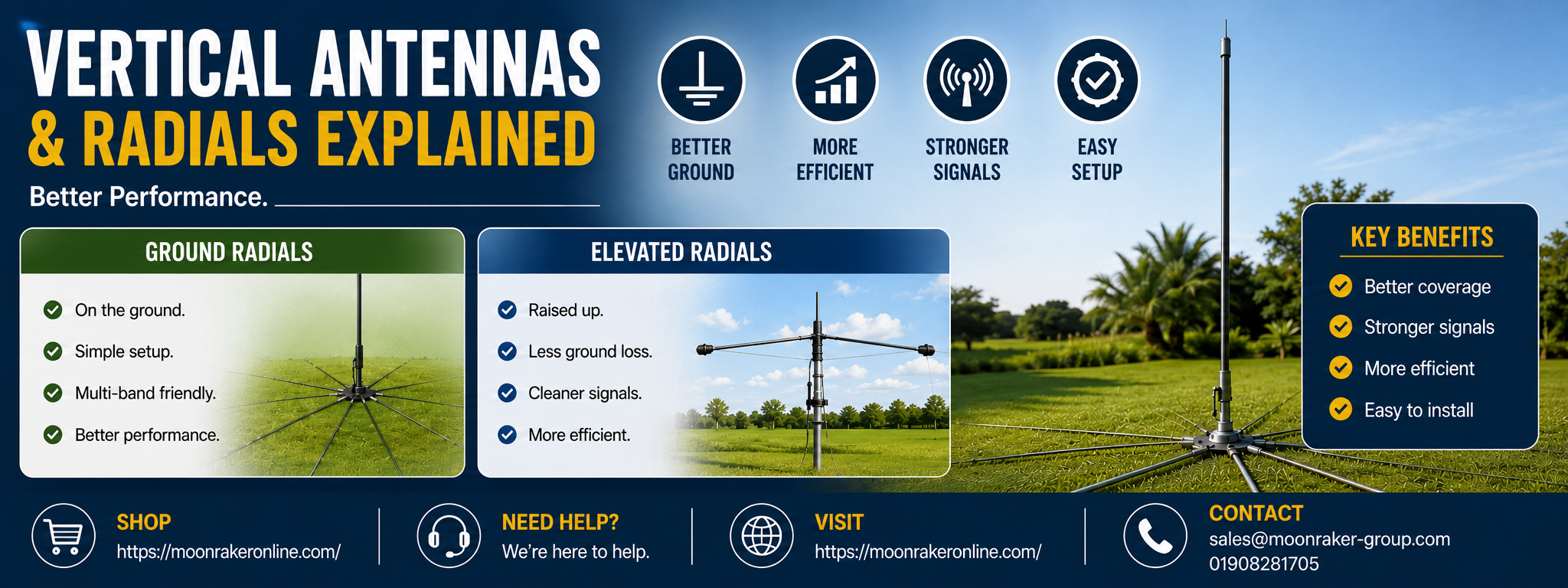
When the longer days arrive and thoughts turn to getting back outside with the aerials, one topic comes up again and again: radials for vertical antennas. It is one of those subjects that can seem more complicated than it really is.
The good news is that the basics are quite straightforward. If you understand why radials are needed, and the difference between ground mounted and elevated radials, you can make sensible choices and get very decent performance without wasting time or wire.
Why vertical antennas need radials
An antenna is fundamentally a two-pole device. A dipole makes this obvious because you can clearly see the two halves of the antenna, one on each side of the feed point.
A vertical, on the other hand, looks like a single element. That creates the obvious question: where is the other half?
If you simply plant a vertical in the ground, connect some coax, and call it done, it will radiate. The trouble is that it will do so very inefficiently. Much of the power disappears into ground losses, and only a small portion is usefully radiated.
That is why radials matter. They provide the missing return path and replace the lossy earth with something much better. In practical terms, the radial system becomes the other half of the antenna.
Ground mounted radials: simple and effective
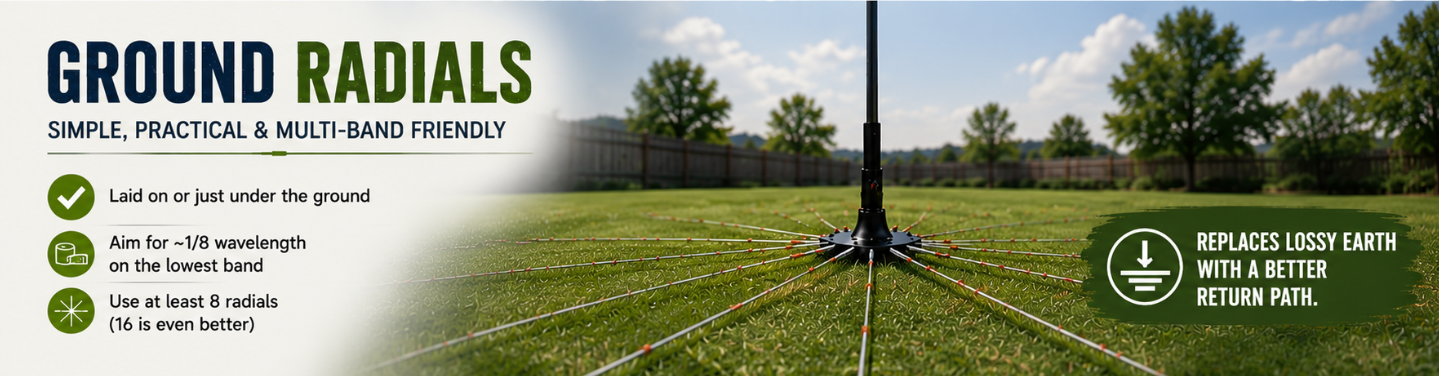
For most installations, the easiest approach is to lay radials on or just under the ground. This works well, especially for multi-band vertical antennas, and it avoids some of the complexity that comes with elevated systems.
Do ground radials need to be resonant?
No. This is one of the biggest misunderstandings.
If the radials are on the ground, forget about trying to cut them to a precise quarter wavelength. They are not going to behave as perfectly resonant radials anyway because of their interaction with the earth. If you spend ages trimming them to an exact length, you are largely wasting your effort.
For ground radials:
- They do not need to be resonant.
- Longer is generally better.
- Almost any radial is better than no radial.
How long should ground radials be?
A very practical rule is to aim for around one eighth of a wavelength on the lowest band you intend to use.
That gives you a good working compromise between performance and the realities of garden size, wire cost, and installation effort.
Examples:
- For a vertical whose lowest band is 20 metres, radials of about 8 feet will do a reasonable job.
- For a 40 metre vertical, try for something closer to 16 feet if space allows.
If you have room to make them longer, fine. If you do not, do not let that stop you. A shorter radial system is still worthwhile.
How many ground radials do you need?
The best number is as many as you can reasonably put down, but there is a point where the returns start to shrink.
A sensible guide looks like this:
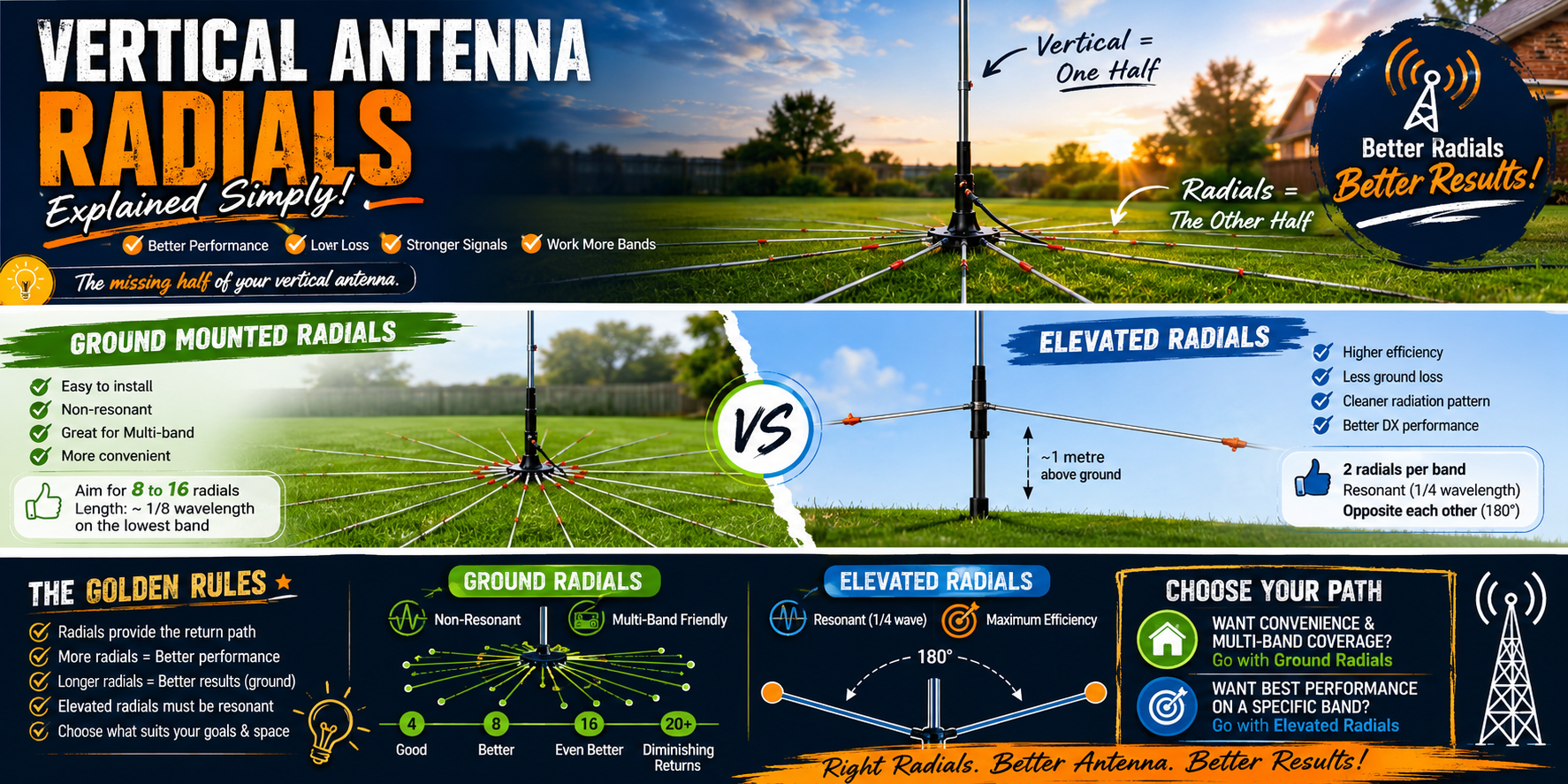
- 4 radials can give acceptable results if they are around one eighth wavelength on the lowest band.
- 8 radials is a very good practical minimum.
- 16 radials is better still and gives a noticeable improvement.
- Beyond 16, improvements continue, but the law of diminishing returns starts to bite.
Once you push past 16 radials, you may end up using a lot more wire for a relatively modest gain. The improvement is real, but it gets progressively harder to notice in day to day operating.
Why ground radials suit multi-band verticals
This is where ground radials really shine. Because they are non-resonant in practical use, they can support operation across multiple bands.
If you build a radial field based on your lowest band, it will work well on higher frequencies too, and it will even provide some benefit below that to a degree. That makes this arrangement particularly attractive for all-band and multi-band vertical antennas.
If you want a simple, workable, low-fuss solution, a ground radial system is often the answer.
The downside of ground radials
There is, however, a catch.
Ground radials are convenient, but they are not the most efficient option if your goal is the very best performance from a vertical antenna. Because they are close to or in contact with the earth, they still couple energy into the ground. That means losses remain part of the system.
So while ground mounted radials work well, they are still a compromise.
Elevated radials: better performance, more constraints
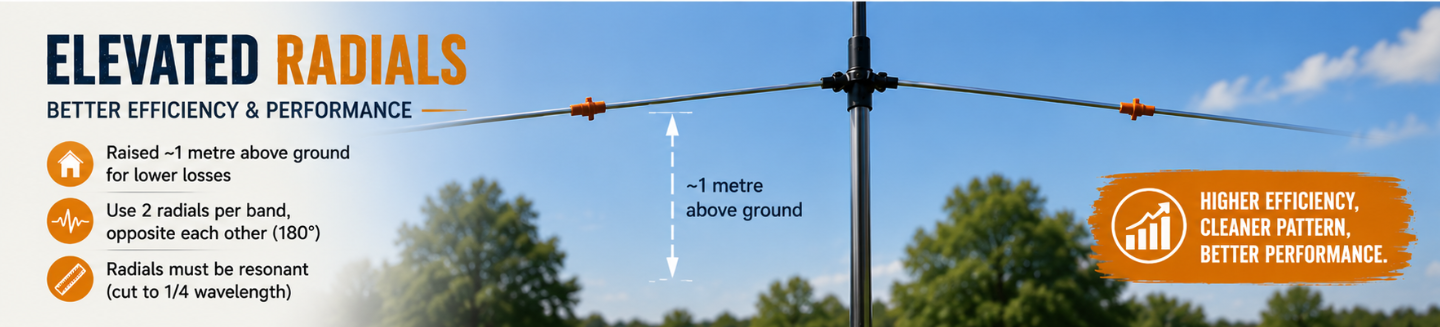
If you can raise the radials off the ground, even by only about a metre, performance improves significantly.
That is because you reduce the losses associated with the earth. Instead of the radial system bleeding energy into the ground, more of that energy is available for radiation.
In fact, a vertical with just two elevated radials can outperform a ground radial system with eight radials on the ground by something like 3 dB. That is a substantial improvement.
How many elevated radials are needed?
For an elevated vertical, two radials per band is generally enough.
They should be placed 180 degrees opposite each other. In other words, directly across from one another.
This arrangement can produce a very efficient vertical antenna system.
The important catch: elevated radials must be resonant
This is the price you pay for the improved performance.
Unlike ground radials, elevated radials do need to be resonant. That means they should be cut to the appropriate quarter-wave length for the band in question.
This has a big consequence:
- If your vertical is single band, elevated radials are straightforward and highly effective.
- If your vertical is multi-band, you will need separate resonant radials for each band.
So while two elevated radials work brilliantly for one band, the other bands will suffer unless they also have their own properly sized radial pairs.
Browse Our Connectors:
-
 UK to USA Travel Adaptor£2.95
 -
 RIG EXPERT Shackmaster OSL Kit£199.95


Single-band versus multi-band: choosing the right approach
This really comes down to what you want from the antenna.
If you want convenience and all-band coverage
Use a vertical with ground mounted radials.
Aim for:
- At least 8 radials
- Preferably 16 if possible
- Lengths around one eighth wavelength on the lowest band
This is practical, flexible, and works well across multiple bands.
Our Antenna Analysers:
-
 B - GRADE RigExpert Match Antenna Analyser (0.1-70MHz Upgradeable to 500MHz)Special Price £256.95 Regular Price £329.95
 -
 Chelegance NANOVNA-F V3 VNA 6GSpecial Price £279.95 Regular Price £299.95
 -
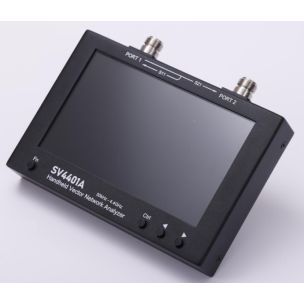 Chelegance SV4401A VNA Network AnalyserSpecial Price £329.95 Regular Price £349.95
 -
 RigExpert - Match Analyser License (Full Upgrade to RFE) (500Mhz)Special Price £149.95 Regular Price £179.95
 -
 RigExpert - Match Analyser License (Upgrade Basic to Advance) (230Mhz)Special Price £69.95 Regular Price £89.95
 -
 RigExpert Match Antenna Analyser (0.1-70MHz Upgradeable to 500MHz)Special Price £279.95 Regular Price £329.95
 -
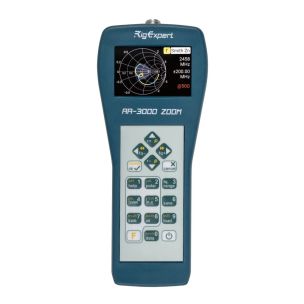 RigExpert AA-3000 Zoom (0.1 to 3000MHz) AnalyserSpecial Price £1,099.95 Regular Price £1,199.95
 -
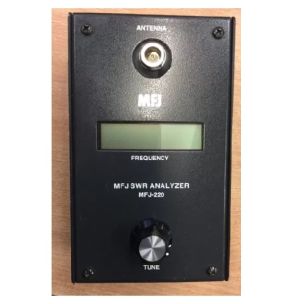 MFJ-220G SWR analyser 140-260MHz£229.95
 -
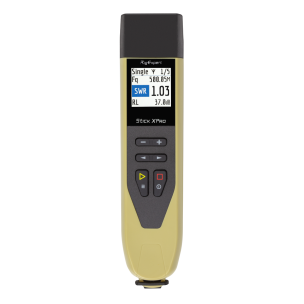 RigExpert Stick XPro (0.1 - 1150MHz) AnalyserSpecial Price £449.95 Regular Price £499.95
 -
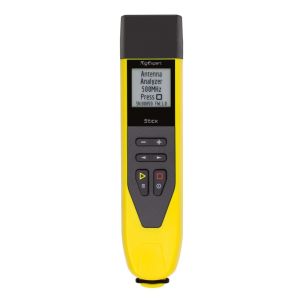 RigExpert Stick 500 (0.1-500MHz) AnalyserSpecial Price £319.95 Regular Price £399.95


If you want the best performance on a particular band
Use elevated resonant radials.
Raise the system roughly 1 metre above ground if you can, and use:
- 2 radials per band
- Quarter-wave radials
- Positioned 180 degrees apart
This is an excellent route for a monoband DX vertical.
An example: a 20 metre monoband vertical
Suppose you build a vertical for 20 metres. The radiator would be around 16.5 feet high. If you then add two quarter-wave elevated radials, opposite each other, you end up with a very efficient DX antenna for that band.
It is a superb arrangement if 20 metres is your main focus.
The trade-off is that it is really optimised for that single band. If you want broad multi-band capability, the ground radial approach is usually more practical.
Another benefit of elevated radials
There is also a less obvious advantage to getting the radial system off the ground.
Elevated radials often help produce a cleaner radiation pattern. They also tend to make the vertical less susceptible to the influence of nearby objects such as:
- Buildings
- Poles
- Other surrounding structures
That can make the antenna behave more predictably, which is always welcome.
The old-school approach still works brilliantly
For many years, verticals were commonly installed up in the air rather than right at ground level. They might be 10, 15, or 20 feet up, with resonant radials for each band. Those systems worked extremely well, and in many ways they remain close to the ideal arrangement.
If your site and support structure allow it, a vertical elevated well above the ground with proper resonant radials is hard to beat.
But in the real world, not every station has that luxury. If all you can manage is around a metre of elevation, it is still enough to make elevated radials worthwhile.
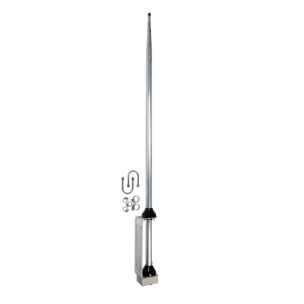
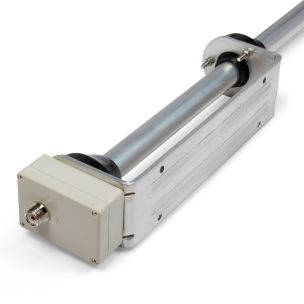
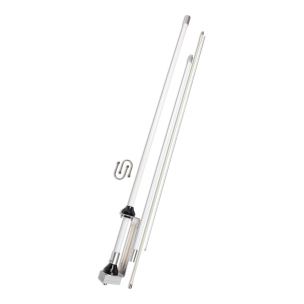
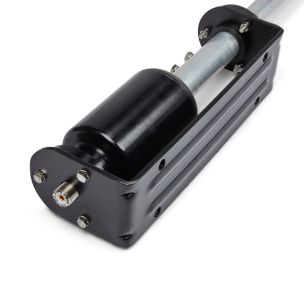
Our Vertical Antenna's Collection:
-
 Hustler 4-BTV 10-40M HF Vertical£299.95
Practical summary
If you want the short version, here it is.
- Vertical antennas need radials because they need a return path and the earth alone is too lossy.
- Ground mounted radials are easy, multi-band friendly, and do not need to be resonant.
- Use at least 8 ground radials if possible.
- 16 ground radials is better, but beyond that the gains become smaller.
- Length is not critical for ground radials, though longer is better. Around one eighth wavelength on the lowest band is a sensible target.
- Elevated radials offer better efficiency and can outperform many more ground radials.
- Two elevated radials per band is usually enough.
- Elevated radials must be resonant, which makes them less convenient for multi-band use unless you install separate radials for each band.
Browse Our COAX Solutions:
-
 M&P - Airborne 10 CoaxAs low as £3.15
 -
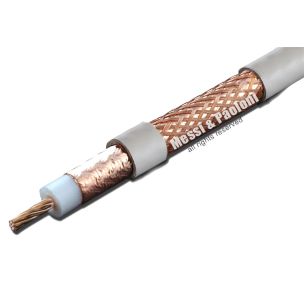 M&P - Ultraflex 10C Sahara CoaxAs low as £3.50
 -
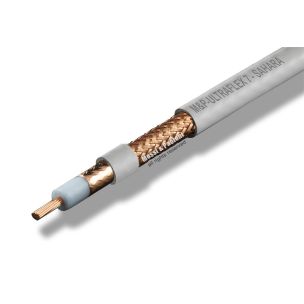 M&P - Ultraflex 7 Sahara CoaxAs low as £2.30
 -
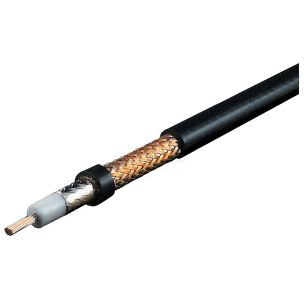 M&P - Extraflex Bury 7 CoaxAs low as £2.30
 -
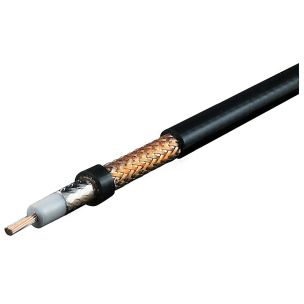 M&P - Ultraflex 7 CoaxAs low as £2.30
 -
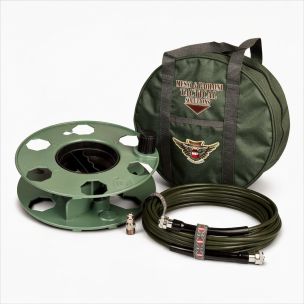 M&P STEALTH-FLEX7-50F (15m) Bundle (Stealth)Special Price £129.95 Regular Price £149.95
 -
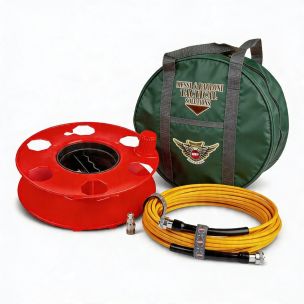 M&P POTA-FLEX7-50F (15m) Bundle (Green Bag)Special Price £129.95 Regular Price £149.95
 -
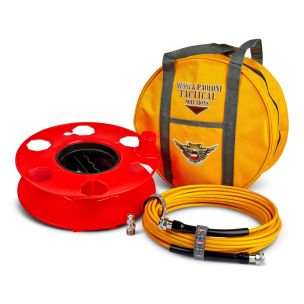 M&P POTA-FLEX7-50F (15m) Bundle (Yellow Bag)Special Price £129.95 Regular Price £149.95
 -
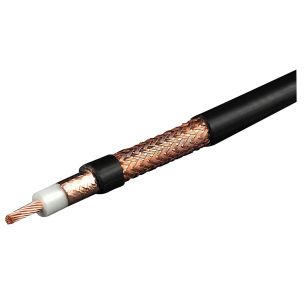 M&P - Extraflex Bury 10C CoaxAs low as £3.60
 -
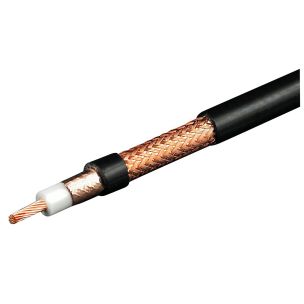 M&P - Ultraflex 10C (Competition) CoaxAs low as £3.50
 -
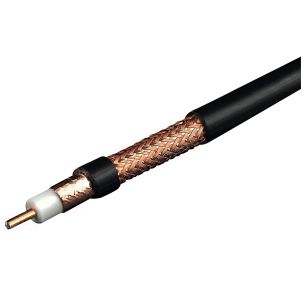 M&P - Broad-Pro 50c CoaxAs low as £4.25
 -
 M&P - POTA-FLEX 7 CableAs low as £4.50
 -
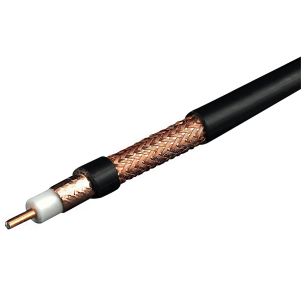 M&P - Hyperflex 5 CoaxAs low as £1.80
 -
 M&P - Airborne 5 CoaxAs low as £1.35
 -
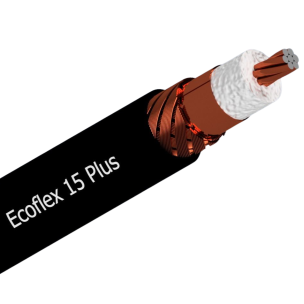 SSB - Ecoflex 15 PLus (Low Loss Coax) (15mm)As low as £10.95
 -
 SSB - Ecoflex 15 (Low Loss Coax) (15mm)As low as £8.95
 -
 SSB - Ecoflex 10 (Low Loss Coax) (10mm)As low as £5.25
 -
 SSB - Aircell 7 (Low Loss Coax) (7mm)As low as £3.95
 -
 SSB - Aircell 5 (Low Loss Coax) (5mm)As low as £2.75
 -
 FZ400CU (LMR400) Super Low Loss CoaxAs low as £2.25
 -
 RG174 Mil Spec (50 Ohm) Super Thin CoaxAs low as £0.50
 -
 Mini8 Mil Spec (50 OHM) CoaxAs low as £0.90
 -
 Formula Zero Mil Spec (50 OHM) CoaxAs low as £2.00
 -
 RG58 Mil Spec (50 OHM) CoaxAs low as £0.60
 -
 RG58 Standard (50 OHM) CoaxAs low as £0.45
 -
 RG213 Mil Spec (50 OHM) CoaxAs low as £1.75

The real answer
There is no single perfect radial system for every station. The right answer depends on the balance you want between simplicity, available space, number of bands, and absolute performance.
If you want easy installation and broad coverage, put down a decent set of ground radials and get on the air.
If you want the best performance on a chosen band, raise the radial system off the ground and use resonant elevated radials.
Either way, the key point is this: radials are not an optional extra for a vertical antenna. They are a vital part of the antenna system, and getting them right makes a huge difference.
For more information please visit our online store or alternatively contact us and our team will be happy to assist you.